John Q
 for violence, language and intense thematic elements.
Reviewed by: Eric Schmidt
CONTRIBUTOR
| Moral Rating: | Average |
| Moviemaking Quality: |
|
| Primary Audience: | Teens Adults |
| Genre: | Action / Drama |
| Length: | 1 hr. 58 min. |
| Year of Release: | 2002 |
| USA Release: |
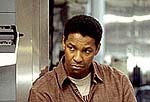
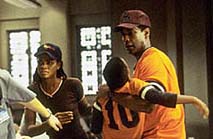
| Featuring | Denzel Washington, Robert Duvall, Anne Heche, James Woods, Eddie Griffin |
| Director |
Nick Cassavetes |
| Producer | Mark Burg, Oren Koules |
| Distributor |
 New Line Cinema, division of Warner Bros. Pictures |
In today’s American society, our health care insurance dilemma is outrageous, and “John Q” had the potential to make not one moviegoer unaware of how serious this problem really is.
The film, directed by Nick Cassevetes, begins with a shot of an open highway. The shot ends with a horrific car accident where a beautiful woman is killed—and it is obvious then this woman will be instrumental in making everything good and well at the end of the film. We then jump to the lives of John Q. Archibald (Denzel Washington), his wife Kimberly, and his son Michael. One morning, the family car is seized by Michael’s insurance company. John, it seems, has been reduced to twenty hours a week in the factory where he works. As of then, the family is completely uncertain about how their financial situation will stand.
They do, however, try to go back to their normal lives, which consist of attending their community church and Michael’s baseball games. Things take a sudden turn, though, when the seemingly healthy boy collapses while running to second base one Sunday afternoon. He is rushed to a quality Chicago hospital, where it is determined that Michael’s heart will soon be useless, as it is already three times normal size. Hospital administrators (James Woods and Anne Heche) give the family two choices: either pay for a heart transplant which may or may not succeed, or try to make Michael’s life as quality as possible during the months or weeks he has left to live.
As most families would, the Archibald’s decide within seconds that a transplant is their ONLY option, but are then hit with the hard reality that because of John’s lack of work, his insurance has been dropped from full-time to part time. The hospital “does everything in their power” to help Michael and his family. Neighbors help the family raise $22,000, but this figure is nowhere near the down payment of $75,000 necessary to get Michael’s name on a donor’s list. John has exhausted all of his options by the morning when the hospital is going to release Michael from treatment. His wife’s pleas for John to “do something!” cause him to buy a gun, lock down the hospital, kill the elevator power, and hold everybody hostage, threatening to hostage situation negotiator Frank Grimes (Robert Duvall, who makes even the worst movies watchable) that there will “be some dead bodies in here” if Michael has not been issued a new heart by 5:15 that evening.
All the while I kept thinking, “Is this really what a father would do?” and “John Q” almost made me believe it, until the film took on your standard plot for any movie about a hostage situation. When the movie was solely about a father’s love, I almost bought it; when it came time for the first gunshot opportunity on the gunman, I thought “Maybe not.” When a computer genius hacked into an emotional telephone call between John and his wife and broadcast it live over television, this movie had turned from us rooting from Michael to rooting for John Q. When comic relief started to take its toll in the form of conversations between John and the eclectic mix of hostages he has taken under his belt, I wish I would have walked out. Even the final climactic minutes, where John debates whether he should kill himself and give his heart to Michael do not undo everything else thrown in unnecessarily.
Again, this movie had the potential to say something that would hit medical insurance companies deep, but instead it turns into a laughable, completely unplausable film. If the intention of the filmmakers, who incidently spent eight years writing the script (it seemed like it was eight days), was to send a message to insurance companies, they would have done well to skip the entire hostage situation and make this into a heart-breaking courtroom drama. I get the sickening feeling that the hostage crisis might have just been created as a draw to teenage audiences.
From a Christian standpoint, I suppose the film glorifies violence as a means of solving a problem. There also is plenty of strong profanity, including two “F” words, 10 “s” words, and many, many uses of the Lord’s name in vain by many of the hostages. There is also a side plot that in no uncertain terms establishes a hostage as a wife-beater.
However, I did like how in the final waning moments of the situation, John realized that a miracle from God was his last hope.
But, in retrospect, this film does not have the potential to offend simply because of certain anti-Christian elements, but also because it takes a very serious issue and through the usage of unneeded material and plot lines, makes it into a farce. The sad thing is that intelligent filmmakers won’t want to touch this worthy material for some time now.


[Better than Average / 3½]
[Average / 3½]
[Average / 4]
[Better than Average / 4]
[Better than Average / 5]
[Better than Average / 5]
[Better than Average / 4]
[Better than Average / 4½]
[Average / 1½]
[Average / 4]
My Ratings: [Better than Average / 4]