The Count of Monte Cristo
 for adventure violence/swordplay and some sensuality.
Reviewed by: Douglas Downs
STAFF WRITER
| Moral Rating: | Better than Average |
| Moviemaking Quality: |
|
| Primary Audience: | Adults Teens |
| Genre: | Action Adventure Crime History Romance Thriller Drama Adaptation |
| Length: | 2 hr. 14 min. |
| Year of Release: | 2002 |
| USA Release: |
January 25, 2002 (wide) DVD: September 10, 2002 |






Lying in the Bible
REVENGE—Love replaces hatred—former israeli soldier and an ex-PLO fighter prove peace is possible-but only with Jesus
prison in the Bible
SUICIDE—What does the Bible say? Answer
If a Christian commits suicide, will they go to Heaven? Answer
How can we know there’s a God? Answer
What if the cosmos is all that there is? Answer
If God made everything, who made God? Answer
Is Jesus Christ God? Answer
treasure houses in the Bible
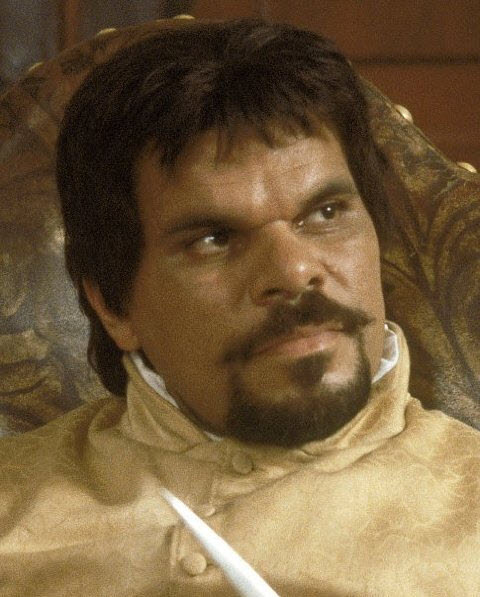
| Featuring | James Caviezel (Edmond Dantes), Guy Pearce (Fernand Mondego), Richard Harris (Abbé Faria), Luis Guzmán (Luis Guzman) (Jacopo), Henry Cavill (Albert Mondego), See all » |
| Director |
Kevin Reynolds |
| Producer | Touchstone Pictures, Spyglass Entertainment, World 2000 Entertainment, Epsilon Motion Pictures, See all » |
| Distributor |
 Touchstone Pictures, a division of Walt Disney Studios |
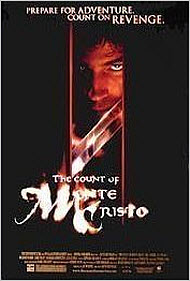
“Prepare for adventure. Count on revenge.”
Twelve times Hollywood has turned to this enduring story of conflict, betrayal, revenge, and romance by Alexandre Dumas. It is hard to mess up a well written story. The first time this drama was captured on film was in 1912. I personally enjoyed the 1974 version with Richard Chamberlain in the lead. In this version, Kevin Reynolds directs a masterful presentation for a new generation of viewers. Reynolds, whose films include the lively Kevin Costner films “Robin Hood: Prince of Thieves” and “Waterworld” is very comfortable with larger than life translations of compelling stories. The scenery of Malta and Ireland give this film a lush richness that is difficult to ignore.
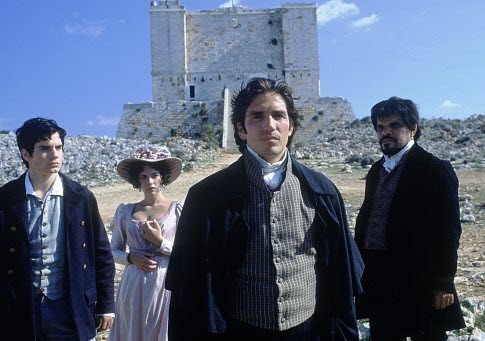
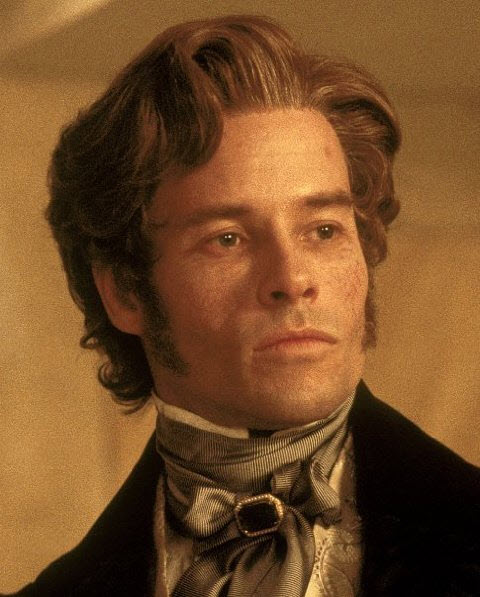
Our story begins with our hero Edmund Dantes (James Caviezel) and his friend, Mondego (Guy Pearce) trying to save the captain of their ship. They seek refuge on an island where the emperor Napoleon is living in exile. Napoleon takes advantage of the goodness he sees in Edmund and asks him to deliver a letter. This seemingly innocent request catapults our hero from the rank of Captain into the shame of imprisonment. His greatest crime is that his best friend Mondego is in love with his fiancee, Mercedes (Dagmara Dominczyk). A jealous betrayal and a public official’s protection of his father lead Edmund into captivity in the famous Chateau D’If prison located on a barren island. Every year of his imprisonment he is beaten, and daily he traces over the inscription in his cell “God will give me justice.” Just when things seem to get worse, Abbe Faria (Richard Harris) pops in (literally).
This priest encourages Edmund, who is wavering in his faith, and the two contemplate escape. At one point of despair, Edmund exclaims “I don’t believe in God!” and the Abbe replies, “it doesn’t matter—He believes in you.”
Just as the two are nearing an opportunity to escape, Abbe is injured and gives his trusted friend a map to a large treasure. Edmund finds the treasure and uses the money to reinvent himself, plotting revenge against his betrayers. His anger almost begins to eclipse his capacity for mercy.
The “PG-13” rating should be observed. The film is sparse in the area of language (Kids-in-Mind reports “1 scatological term, 4 mild obscenities, several insults, 17 religious exclamations”), but it takes its full share of violence. There are two scenes where we witness someone being run through with a sword (blood included). There is also some premarital sex implied and infidelity excused. It is not a perfect film, but there are some lessons to be learned.
I liked this new version of “The Count of Monte Cristo” and would recommend it with the above reservations.
See list of Relevant Issues—questions-and-answers.


This is a VERY clean film. They didn’t show half of what they could have shown (and usually do). I could easily recommend this to teens (with a bit of talk about the premaritial/adulterous sex bit, which is not much more prominent or objectionable than in films like “You’ve Got Mail.”)
I actually enjoyed this more than “Lord of the Rings,” which I’ve seen twice. The characterizations and plot points are much clearer; the goals and motivations of the characters are plain. I have not read the book, so can’t speak to that. I thought the movie was very well done, and I would like to see it again.
[Better than Average / 5]
As with most movies, Christians cannot rely on the flickering screen to impart the message of the gospel; it is up to them to take what is there and use it as the basis for a personal discussion, whether it be with their friends, their coworkers, or their own family. The concepts of sin and forgiveness are clearly present in “The Count of Monte Cristo”; will you, as a Christian viewer, be content to decry the moral faults of the movie, or will you use it as a springboard to reach others?
Yes, it has its moral faults—the entire revenge motif; premarital and adulterous relations between Edmond and Mercedes; violence and murder as a means to an end. But, in the words of Mercedes, “Even a sin can become a miracle.” The film has a strong moral underpinning (which comes out much more clearly in the novel). Many will go to this movie for the romance and the action; use that moral underpinning to reach them on a deeper level!
[Better than Average / 4]
As for morality, things are more implied than blatant. The language is clean, the violence is average (two fairly gruesome sword deaths) and the sexuality is less than that of your average soap opera or primetime series. If the end of the story bothers you (revenge seems to be the answer to your problems by the end) read the book. It paints a bit of a different picture.
[Better than Average / 4]
[Excellent! / 5]
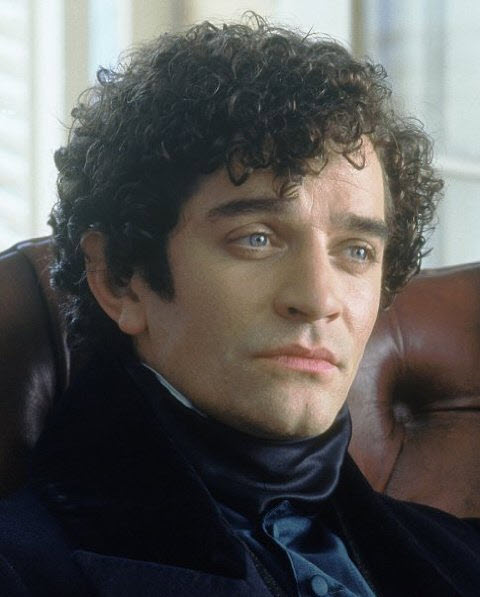
Kevin Reynolds (the visionary behind “Robin Hood: Prince Of Thieves”) directs from a screenplay by Jay Wolpert (who received story credit on “Pirates Of The Caribbean: The Curse Of The Black Pearl.”). The cast includes Jim Caviezel (who would go on to his next-famous role in “The Passion Of The Christ” after this movie), Guy Pearce, the late Richard Harris, Dagmara Dominczyk, James Frain and the ubiquitously villainous Michael Wincott (playing—you guessed it—another villain). The cast and production values are first-rate, as one would expect from a Hollywood adaptation of a classic novel.
Biblically speaking, there’s very little offensive content, as the movie was distributed via Walt Disney Pictures’ subsidiary Touchstone Pictures. There’s an implied sexual situation early in the movie (only bare shoulders are seen, as the camera is a discreet distance away), and some violence (featuring swords, of course, one execution-style shooting and an attempted murder, again with a pistol) with little to no blood.
There are also some non-profane uses of “Hell,” “God,” “Bastard,” and “Whore.”
In fact, God is frequently mentioned in this reimagining, but always reverently. I highly commend the use of Christian themes in this retelling of a classic novel (which had sparse references to God, and His justice, which play a MAJOR role here), as that is rare for a Hollywood production these days. Kudos to Walt Disney Pictures for making yet another excellent family movie and for inserting a Christian worldview into the story.
Maybe viewing this film will get fans of the cast (who may have not read the 1492 page novel) interested in reading the book. I think the film should have been rated PG, as there’s very little objectionable material here, and there are PG-13 movies that have R-rated content (“Titanic” and “The Color Purple,” for instance).
The DVD is well worth getting, as it includes deleted scenes with optional director commentary (though I lament that a scene and a line featured in the trailer were not included as deleted scenes), a 4-part featurette on the making of the movie, a sword-fighting featurette and a feature-length audio commentary by director Kevin Reynolds.
Moral rating: Better than Average / Moviemaking quality: 5
There are some violent fights and some literal body piercing, but those scenes served to show the violence of that period of history and didn’t seem inappropriate. The director captured the essence of Napoleonic France (although it’s filmed in Ireland and Malta!) and the sets, the scenery, the acting and costumes were excellent. Richard Harris was great! There are many references to God and His justice, but this is lost in the revenge motif throughout most of the movie with a capital “R”.
In the end you are swept along with Edmond’s desire to destroy everyone and everything and you, the movie viewer, don’t rest until justice is served. You want to see the bad guys suffer and die horribly. Edmond is urged to forgive and move on with his life, but he sweeps those Christian principles aside with gusto. “Vengeance is mine,” saith… Edmond.
By the end you feel disappointed in the film for enticing you to enjoy paybacks and for the constant altering of the original classic, so that it becomes a Hollywood invention and not Alexander Dumas’s tale at all. Is he turning in his grave? R.I.P. Alex. Many will love it, even if you and God don’t! At PG-13 it’s not good for a teenager’s Christian and educational learning curve at all.
[Average / 4½]
The director had this to say: “It’s just not very cinematic. One of the problems with the book is that it’s just a lot of people walking into ornate rooms and spewing exposition to each other… So out of necessity we had to take some dramatic license with it.” Dramatic license… you could say that! This “dramatic license” included the addition of fornication between two characters who, in the original story, specifically stated that they were not doing so, and were waiting until they could be married—and many years later they are back in bed together, despite the fact that one of them is married to another person.
I heard a Christian reviewer raving about the movie, I assume from the mere inclusion of God’s name used for a purpose other than cursing: Edmund (the protagonist) goes from believing in the sovereignty of God to believing God doesn’t exist at all, and then believing again after he has got his revenge. I suppose that is what so impressed that Christian reviewer (though I am told that in the book, Edmund’s imprisonment does not cause him to doubt God, but rather to rely on Him more fully).
However, I was struck by the statement from the woman at Edmund’s protests that God is not real: “God is in everything. Even in a kiss.” And then she gives a kiss: an adulterous kiss. Uh, yeah, babe, you might want to check out a few passages in your Bible to see what God would think of what you’re about to do. At any rate, they made quite a few of what I believe to be mistakes (such as turning one of the characters into a far too silly and rather modern sounding oaf, and putting in a scene with a hot air balloon that is supposed to be grandiose but was really just ridiculously corny… the list goes on and on, and I’m sure readers of the book could enlighten us much further).
The merit to the movie is that there is little or no language, no on-screen sex scenes (though it is strongly implied), and no gratuitous blood and gore. If you’re looking for a diversion and you have no other choice, you may like the movie a bit more than I did.
[Average / 3]
[4½]
[Better than Average / 3½]
My Ratings: [Better than Average / 4]