The United States of Leland
 for language and some drug content.
Reviewed by: Chris Monroe
STAFF WRITER
| Moral Rating: | Offensive |
| Moviemaking Quality: |
|
| Primary Audience: | Adults |
| Genre: | Crime/Gangster and Drama |
| Length: | 1 hr. 48 min. |
| Year of Release: | 2004 |
| USA Release: |
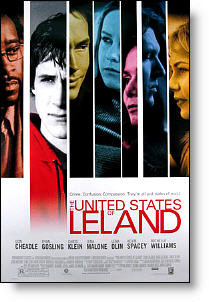




| Featuring |
|---|
|
Don Cheadle Ryan Gosling Jena Malone Lena Olin Kevin Spacey |
| Director |
|
Matthew Ryan Hoge |
| Producer |
| Kevin Spacey, Bernie Morris, Palmer West, Jonah Smith |
| Distributor |

Visiting “The United States of Leland” is an interesting stop that invokes an honest look at life and discusses excellent, challenging ideas. There are some great biblical concepts that are paralleled throughout the story, but in the end, it feels like it is out to preach its own version of goodness.
In suburban life Arizona, high schooler Leland P. Fitzgerald (Ryan Gosling), son of renowned author Albert P. Fitzgerald (Kevin Spacey), is arrested for murdering his ex-girlfriend’s mentally handicapped brother. While in a detention center Leland’s mentor, Pearl (Don Cheadle), an aspiring writer, takes a vested interest in Leland with hopes of using his story for a new book. Day by day, Leland divulges more and more about his life and consistently confronts the status quo of society. Eventually, Leland’s actions affect him and those around him until they end up changing in some way—either for good or for evil.
There is some foul language at certain moments and a scenario involving drug use. There is no sex scene, but one scene involves Pearl making out with a woman, and it is understood that they sleep together. Both of these situations ultimately have a negative result. Another scene depicts Leland laying fairly intimately next to an older, divorced woman, and we can infer from the story that they had sex. There are also a couple incidents of violence, but they refrain from being overly graphic.
The story has a clear plot, but the focus of this film is on the character of Leland. As we learn more about this disenchanted youth, he expresses how he began to see beyond people’s exteriors and past their facades. What he claims to have discovered is a real sadness in people. Leland’s insight hits on an idea found in Proverbs 14:13, which says, “Even in laughter the heart may be in pain and the end of joy may be grief.” Socially, Leland comes across as very detached from people, but he is unique in having tapped into something very honest and real.
Along with this idea, the film also addresses the belief that human beings are fallible. Romans 3:23 says “all have sinned.” Pearl tells Leland during one of their meetings that even with our (humans’) best intentions, we still mess up. Leland, however, surprises Pearl, when Leland confronts him about cheating on his girlfriend. Pearl wrestles with this sin (though they don’t term it “sin”), and it challenges him to take a hard look at his actions. This results in arguably the best, most clear example of redemption in the film. Coincidentally, Pearl’s influence on Leland is not without effect.
Another biblical parallel I drew from this film coincides with Jesus’ parable in Matthew 21:31. In it, Jesus contrasts two sons both asked by their father to go to work. One says he will go work, but doesn’t. The second son says no, initially, but changes his mind and ends up going. The point Christ makes is that those who seem like they’re doing right are really not, while those who are failures (“sinners”) become righteous when they repent. Several characters Leland knows can be likened to each one of the sons.
I felt this film wanted desperately to tell a redemptive story. The previously mentioned elements prompted hope for something great—and there were even moments where the movie took me there emotionally—but, in the end, I felt there was something missing. Eventually it became far too preachy and resulted in purporting its own idea of goodness rather than the truth.
Examples of this are found during Leland’s narration, particularly on his ideas about God. Early on, he says that he thinks people waste their time by crying and praying. He says the Devil makes more sense than God, because it’s good for us to have someone to blame for all the bad stuff that happens. Later, he says that maybe God and the Devil are having a tug of war, because people do good and evil. They get scared and never know which side they’ll end up on.
It would be interesting if these theories were an honest search for truth, but by the end it felt these ideas were projected in order to preach their own ideas of goodness. In his final narration, Leland entertains the thought that if God doesn’t exist, then it could just be “good inside of us.” He suggests that between the good and evil that we do, we just need to practice the good more often. Truth is, none of us are good truly without God.
These sketchy ideas, along with the fact that it almost seems Leland thinks he was helping the mentally handicapped boy by killing him, created dislike for the film overall. The dialog and acting are okay—as well as the nice, natural lighting—but nothing was outstanding. It all served its own purpose, which I disagreed with.


He is sent away to a correctional facility where Pearl Madison (played by Don Cheadle) wants to find out Leland’s story, mostly so that he can write one of his own about Leland. So, they have one on one session. At first Leland says that people only want to know “why” something happened so that they can forget about it. Bury it. Wrap it up in a nice neat bow He says that people only fake being happy to hide their own sadness. He theorizes about God and people, as if, that’s right, he can wrap up the sum of existence into a nice neat bow. this is where the movie goes wrong. It turns the confusion of a teenager into the truth the world must hear. My biggest problem was that there was no one in the movie to question Leland’s theories. Leland is wrong. But no one in the movie is smart enough to tell him he’s wrong, and why. So by the end of the film, we get a very skewed version of life.
But, the film could have even worked had it isolated those feelings and applied them merely to this sad situation. But it swings for the fences. It wants to be about everyone, everywhere, and it’s just wrong. I fear that people who have had even somewhat sad lives will feel almost doomed by this movie.
“The United States of Leland” does have moments that, if followed through in the rest of the movie, could have created a very good, perhaps even great story. There is a scene where Leland asks Pearl why he has cheated on his girlfriend. Pearl says that he is only human, and Leland’s response is powerfully insightful. “Isn’t it funny how people only say that after they’ve done something bad? No one ever says that after they rescue someone from a burning building.” This moment is good because it observes, instead of theorizes. It is based on what people do, and gives a subtle suggestion about the nature of people.
Kevin Spacey helped finance the film, and he plays Leland’s father, a writer. I got the sense that Hoge knew exactly what to do with this one character. He is only in a few scenes, but based on them, we would much rather see a movie about him and his son, and cut out all the killing stuff. Spacey is so good at playing men who are left to confront the decisions of the past, and that’s what he does here. I can see why he was attracted to the script. the ideas are interesting, and it has the suburban setting that garnerd so much admiration for “American Beauty.” But it really isn’t used well here, and most of the characters aren’t interesting enough to be involved in.
There IS happiness in this world. there is contentment. This is not a perfect world. We have the ability to do good all the time, but no one ever does. Why not? Because we are sinful creatures. That is why we need the redemption offered in Jesus. Now, I wasn’t looking for the movie to take a Christian route, but the truth is, bad things happen. We learn from them. A perfect world would not be a world without sadness. A perfect world would be one in which everybody knew how to deal with that sadness. This attitude was modeled by one man, a little over 2,000 years ago. He was PERFECT, but he endured sadness, pain and suffering. Did that make him imperfect? No. Because he knew how to handle it. I am aware that I have not explained all of my thoughts perfectly, but I hope and think there is a basis of truth in there. One that is not found in “The United States of Leland.”
My Ratings: [Average/2½]