North Country
 for sequences involving sexual harassment including violence and dialogue, and for language.
Reviewed by: Kenneth R. Morefield, Ph.D.
CONTRIBUTOR
| Moral Rating: | Better than Average |
| Moviemaking Quality: |
|
| Primary Audience: | Adults |
| Genre: | Drama |
| Length: | 2 hr. 6 min. |
| Year of Release: | 2005 |
| USA Release: |
October 14, 2005 (wide) |






| Featuring | Charlize Theron, Frances McDormand, Sissy Spacek, Woody Harrelson, Sean Bean |
| Director |
Niki Caro |
| Producer | Nick Wechsler, Helen Bartlett, Nana Greenwald |
| Distributor |
 Warner Bros. Pictures, a Warner Bros. Entertainment Company |
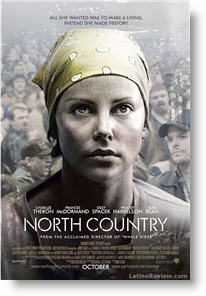
All she wanted was to make a living. Instead she made history.
Plot: After suffering from domestic abuse, Josey Aimes (Charlize Theron) returns to her home in Minnesota, where she takes a job working for a coal mining company. When Josey and other female miners are met with escalating sexual harassment, she eventually files a class action lawsuit against the mining company.
“North Country,” because of its subject matter, is the sort of film that is pointless to review for “objectionable” content. That is to say, if your primary criteria for evaluating film is the amount of objectionable content (language, drug and alcohol use, violence, sexual behavior) shown in it, then you must inevitably come to the conclusion that you don’t wish to see (or don’t think it is appropriate to see) any film about certain subject matter, because it would not be possible to make a credible film about it without depicting language and behavior that is often deemed objectionable in Christian circles.
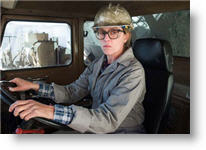
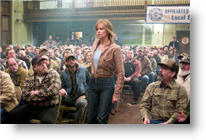
Those who do not think that all depictions of objectionable content are inappropriate will have to consider their context and function within a particular film. To be about what it is about, “North Country” has to show us a lot to make us understand what Josey and the other female miners went through. One woman finds a rubber phallus in her lunch box; obscene words and cartoons are drawn on the walls of their work environment; one character is locked in a portable outhouse that is tipped over, dousing her in excrement; several of the females are groped on their breasts and buttocks; one character is raped (in a flashback).
None of this is depicted gratuitously or for erotic effect, so I did not find the depictions of it to be morally objectionable—I simply recognize that some viewers, like Josey’s mom (who turns off the Senate hearings into Anita Hill’s allegations of sexual harassment against Clarence Thomas), would prefer not to watch or listen to depictions of some subjects.
For audiences that are willing to think about the subject matter, I thought “North Country” was a good film, but not a great one.
The acting is uniformly strong. Theron is able to make Josey sympathetic without being saintly, and the supporting cast give strong, nuanced performances. Richard Jenkins gives a great supporting performance as Josey’s father, a man who must come to terms with his own disappointment and shame at his daughter’s life choices before he can feel sympathy at her plight. Frances McDormand and Sean Bean play a couple who befriend Josey and provide a compelling portrait of a loving marriage that must come to terms with the impossibility of ever totally separating one’s work life from one’s home. Amber Heard plays Josey as a teenager, and she manages to impress with limited screen time.
If all of this sounds like there is a lot going on in the film besides a brave woman standing up to difficult circumstances, there is. Dramatically, the richness of the plot is both a blessing and a curse. At times, the supporting characters and their story arcs seem more nuanced—and hence more interesting—than the relentless repetition of Josey’s escalating mistreatment.
In addition, the film doesn’t seem entirely confident that the audience will appreciate ambiguity or subtlety, so it tends to drag as it is forced to render explicitly what has already been shown implicitly in earlier scenes. We get not one but three scenes of Anita Hill testifying on television, culminating with dialogue drawing our attention to the similarity between the miner’s situation and Hill’s. Oh, is that why those hearings were being played in the background?
We get a beautifully understated father-daughter reconciliation at home that has to be rendered more explicit with the father’s speech at a union meeting. There is a wonderful scene between Bean’s character and Josey’s son that culminates in the son’s deeper understanding and appreciation of his mother. Though it is enough to have this scene culminate with the son returning home, we have to have a follow-up scene with a long speech from Josey upon his return. He has already softened towards her, and we already know and understand why, but Theron needs her Oscar-baiting monologue, so there it is.
Nowhere is this mix of the thoughtfully subtle and the self-consciously dramatic more grating than in the final courtroom scene, which opts for bombastic music and courtroom theatrics to sledgehammer home the messages that the film had heretofore been carefully crafting with nuance and ambiguity.
The other reservation I had about the film was its lack of insight into the subject matter. I don’t object to a film depicting harsh or objectionable content, but I think one primary difference between a work of art and an entertainment piece is that the former will try to bring some sort of insight into its material. More and more, we are seeing films “based on” or “inspired by” a “true story” as though there is some sort of implicit assertion that saying “this happened” is reason enough to show it.
I might ask, what am I supposed to make of the fact that it happened? What is the point that the film is trying to make? That sexual harassment happens, and it really, really sucks? That men are dogs? That sexual harassment is misdirected anger caused by economic hardship? That people don’t know the difference between right and wrong? That people know the difference between right and wrong but are afraid to confront evil when it is bigger or stronger than they are?
All of these ideas (some of which are mutually contradictory) are floated in the film, but none of them is seriously explored beyond a superficial level. Instead, the film remains content to document one scene after another of examples of harassment rather than ever getting around to articulating some insight or idea about their meaning. I’m not saying the film needs to totally explain (much less justify) the behavior it condemns, only that it’s failure to probe or provide insight into its subject matter is a weakness that makes it a less serious a work of art than it passes itself off as.
“North Country”’s postscript states that the women won a “modest” financial settlement but that what they wanted “all along” was a sexual harassment policy that would protect them and subsequent generations from the sorts of treatment that are depicted in the film. This interpretation conveniently overlooks the fact that Josey approaches her lawyer only after she has quit, and only turns her complaint into into a class action suit after he suggests that such a case would be easier to win. It also rather banally implies that the presence of an official sexual harassment policy will be an effective deterrent to the sort of hazing we’ve witnessed. This inference is maddeningly naive. It is impossible to legislate sinful behavior out of existence; any perceptive viewer will see instinctively that a sexual harassment policy is a step in the right direction, not a solution upon which we can declare a happy ending.
In contemplating why I found this postscript so irksome, I realized that its triumphal gloss turned the film into a success story rather than a social indictment. In doing so, it undercut one of the film’s most important messages: that the conditions depicted in the film are not distant memories of a long-forgotten past. Perhaps two of the most sobering facts underscored by Class Action (the book that inspired this film) is that Lois Jenson (upon whom Josey’s character was based) did not hire an attorney until 1988, and the case was not resolved until 1997.
I can vividly recall my time a college professor in the late 1990s during which it was not at all uncommon for me or the female colleague with whom I team-taught to have students from conservative, Christian homes declare assuredly that feminism was an obsolete and unnecessary relic because women no longer experienced serious discrimination or harassment. Sure, Charlotte Perkins Gilman could be put in a mental hospital by her husband for what we now know was postpartum depression, but women aren’t treated as crazy any more if they report stress.
Sure, Virginia Woolf grew up in a society where women could not vote or own property, but that was yesterday. Charlotte Bronte and Mary Ann Evans might have had to take male pseudonyms to be allowed to write, but they were unfortunate enough to be born in less enlightened times. If “North Country” does nothing else, it reminds us that even though “you’ve come a long way, baby” there is still a long way to go—that is, until it hints that “now that you’ve got a sexual harassment policy in place, baby, discrimination, assault, and oppression are well on their way to being things of the past.”
Would that it were so.
My Grade: B
Violence: Moderate / Profanity: Heavy / Sex/Nudity: Moderate
See list of Relevant Issues—questions-and-answers.


Having read the book “Class Action,” as well as the transcripts from the actual trial, I can say that the events portrayed in the movie were extremely sanitized compared to what actually happened. Of course, there is a timeline issue, but considering that the harrassment took place in 1975, and the case wasn’t settled until 1997, there needed to be a certain amount of artistic license taken.
As to the question of why this film was even created, why not? This was a major landmark case that affected how women are to be treated in the workplace. “Sexual harrassment” was a laughable term before this case went to trial, at least on the Range and in a lot of other rural areas. As women, we take for granted that we can go to work, even a “man’s” job, and be treated with respect, and if we are not, there are “zero tolerance” policies in place that will protect us. The film does tend to gloss over the fact that the women went to court for the primary purpose of creating a sexual harrassment policy, not just to sue for money, or because it would be “new” or “different.” Does a policy stop sexual harrassment? Of course not, but it does send a message that a company cares for all of its employees, and ultimately (after a long, dragged out court case!), the women in the mines got exactly what they had been asking for.
The scenery shots were breathtaking, if not a bit excessive, and I was disappointed that if Niki Caro was going to shoot the beautiful scenery of Northern MN, that she almost completely left out the lakes. But since it took place in the winter, that made sense, too.
So should a Christian see “North Country”? If you can get past the language and are not disturbed by the portrayals of the harrassment that takes place, there are some wonderful messages¯standing by your friends, standing up for your family, strong work ethic, fiercely loving your kids no matter what—these are values that were instilled in me while I was growing up on the Iron Range, and I am happy to show the rest of the country a small glimpse of the harsh, cold, quirky, loving small town that I grew up in and will forever have a piece of my heart.
My Ratings: Average / 4