Jet Li’s Fearless
 for violence and martial arts action throughout.
Reviewed by: Michael Karounos
CONTRIBUTOR
| Moral Rating: | Better than Average |
| Moviemaking Quality: |
|
| Primary Audience: | Adults Teens |
| Genre: | Biography Action Adventure |
| Length: | 1 hr. 43 min. |
| Year of Release: | 2006 |
| USA Release: |
September 22, 2006 |
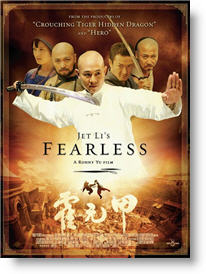
| Featuring | Jet Li, Michelle Yeoh, Nathan Jones, Shido Nakamura |
| Director |
Ronny Yu |
| Producer | William Kong |
| Distributor |

“Fate made him a warrior, courage made him a hero”
“Jet Li’s Fearless” is based on the life of Huo Yuanjia, a master of the Mízōngyì style of fighting in the early 20th century whose life is the source of endless TV movies, documentaries, and films in China. In the West, we are familiar with Huo Yuanjia through the movies of Bruce Lee (“Fists of Fury,” 1972) and Jet Li (“Fists of Legend,” 1994), both of which are excellent examples of the genre and tell the story of Huo’s disciples after his death.
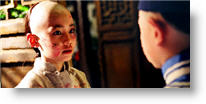
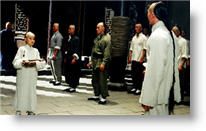
“Fearless” portrays Huo’s childhood, his young manhood, and his adulthood. It is, strictly speaking, a rite of passage movie, showing how Huo overcame his ignorance, pride, and selfish ambition to become a great martial artist and a defender of Chinese pride.
Before that happens, Huo lives his life as an angry young man with a chip on his shoulder. He has a compulsion to prove that he is the best fighter in the city of Tianjin. One of the recurring motifs of the film is a madman who repeatedly asks Huo: “When will you be champion of Tianjin?” Over the length of the movie, the question undergoes an evolution in tone from mocking, to triumphant, to ironic, to poignant. It is a powerful device which reflects Huo’s spiritual progress even more than it does his fighting prowess.
Huo eventually becomes champion of Tianjin, defeating good fighters, foreign fighters, and crowds of fighters along the way. When he begins to drink heavily (a metaphor for how his success has intoxicated him), his mother warns him: “Wushu is not about winning; it’s about discipline and self-restraint.” But it is too late for Huo. When one of his fighters is beaten up by another master, Huo takes his revenge and suffers the tragic consequences.
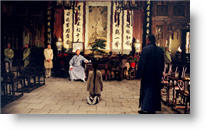
Huo goes into the countryside, where he discovers who he is as an individual, apart from his identity as a fighter. In a sense, he becomes a born-again Chinese, respectful of religious traditions, of his nation’s pride, and of his martial arts. He uses his fighting ability to further the cause of his people and country rather than to glorify himself.
There are moments of pure bravura in the film. The fight scenes are masterful and creative and, above all, convincing. There is very little of the special effects that are used extensively in such films as “Crouching Tiger, Hidden Dragon” or “Hero.” Also, Huo’s transformation from an arrogant bully into a humbled master is moving. Some critics consider that portion of the movie to be “preachy,” but his life with the grandmother and her blind granddaughter, Moon (Betty Sun), provide for instructive moments such as when Moon tells him: “[Although blind], I can see everything in my heart.” The audience understands this to mean that though Moon is blind, she can “see” herself clearly. This contrasts with Huo who, while seeing, does not see himself as he is. The idea resonates strongly with the Christian perspective of those who claim to see but who are blind (John 9:41; 12:40).
When Huo returns from his sojourn, he engages a path of repentance which takes him to his old friend and to the wife of the man he killed. He apologizes to both and is clearly a humbled man. The change in his external conduct bears witness to the change in the inner man and affects everyone around him. Unfortunately, the last portion of the movie degenerates into self-pitying melodrama, which may appeal to Chinese audiences because of the strident nationalism and martyr-like death of Huo, but which will leave others disappointed.
Overall, the movie will appeal to fans of the genre, so long as they understand that there are long dramatic passages. The moral of the movie may be summarized as pride goes before the fall (Proverbs 16:18) and that repentance brings times of spiritual refreshing (Acts 3:19).
The film perhaps is more memorable as a biography of Huo Yuanjia and Li’s farewell to the martial arts genre. It will be enjoyed best by those who can’t wait until it comes out in DVD to see the fight sequences. My advice is to wait.
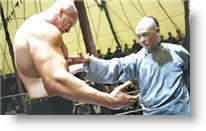
Background: In 1910 Shanghai, China was occupied by four foreign powers: Belgium, England, Japan, and Spain. The Chinese were humiliated in their own streets and foreign fighters, undoubtedly for box office draw, made outlandish statements such as calling China “the sick man of the East.” As it turns out, this is a true incident, reportedly involving a Russian wrestler (https://en.wikipedia.org/wiki/Huo_Yuan_Jia#_note-huozizheng). The movie combines this historical incident with another, that of the actual British boxer Hercules O’Brien (played by the freakishly-large Nathan Jones), who challenged Huo but never fought him.
In the movie, the character of Hercules O’Brien is given the Russian’s 1901 slur and is made, not surprisingly in these anti-American times, to be a brute American. So, the slur the Chinese resented in 1901 from the Russian, the filmmaker’s falsely attribute in 2006 to an American. Although the United States was not one of the imperialistic powers which humiliated China in the early 20th century, the filmmakers went out of their way to portray the American as the most barbaric character in the movie, as a caricature of a human being. Clearly, the purpose for doing so is to symbolically show the Chinese audience that China is greater than the United States. This is an unfortunate example of nationalistic jingoism which doesn’t speak well for the integrity of the filmmakers.
Violence: Heavy / Profanity: None / Sex/Nudity: None
See list of Relevant Issues—questions-and-answers.


Excellent! / 5
Good / 5
In regards to the reviewer’s comment about O’Brien, I agree that it was lame that they made him an American, if he really was a Russian, but I disagree that he was this evil savage brute. His actions were very believeable to me, and he quickly changed. Overall, definitely a good movie for those into martial arts films with NO questionable material what-so-ever.
Good / 4
Fearless is a solid film, and a graceful exit from the genre for Jet Li, the wushu epic genre. Li is not only a good athlete, he is also a good human being, and a good actor. This flick is worth a look. …
Moral rating: Good / Moviemaking quality: 5
Better than Average / 5
Being away for so long, his country have given ways to Western influences and some of it’s ugliness, just like the young Huo. Being called to defend his country’s honors and dignities, Hou accepted the challenge and won—not just for his country, but for himself.
The action sequences are good (as Hong Kong as can be). The story is good (almost Biblically sound). The film could have been better. It is first and foremost a martial art film, but as being based on a true story and about the man who had changed for the better, needs good balance of drama, too, especially during his transformation at the country side. The blind woman who helped him needs to be developed rather than just being there for the sake of the story. I think that if the film was told in flash backs and interweaving the drama and action in parallel juxtaposition, it might have worked better.
Overall, “Fearless” is Chinese Pride. It may seem biased and prejudiced, but it is about one specific group of people. It tells the world and its own people that, being Chinese, it is good and they should be proud of themselves.
Good / 4
none
Good / 4
Excellent! / 5
It is hard to recall all of the moral virtues extolled in this movie, there were so many: love of parents and children, friends, one’s people, and even strangers and enemies; hard work with an eye to quality; the beauty of the simple life of the poor; appreciation and love of the handicapped; discipline; the superiorty of wisdom, skill, discipline and speed over raw might; the dangers of debt and overspending; an abhorance of cruelty, the pitfalls of wine and drunkenness; the destructiveness of pride and arrogance; and the beauty of humilty, repentance and forgiveness.
An especially good movie for boys and men, because it promotes the importance of channelling that love for action that all men have in the right direction. However, I do not want to downplay the fact that my wife really enjoyed it, too!
My Ratings: Excellent! / 5