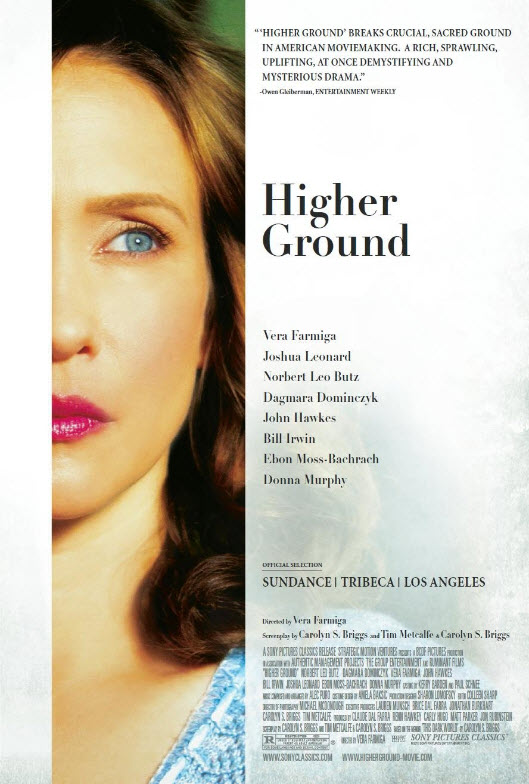
Higher Ground
 for some language and sexual content.
Reviewed by: Julia Webster
CONTRIBUTOR
| Moral Rating: | Offensive |
| Moviemaking Quality: |
|
| Primary Audience: | Adults |
| Genre: | Drama |
| Length: | 1 hr. 49 min. |
| Year of Release: | 2011 |
| USA Release: |
August 26, 2011 |







How do we know the Bible is true? Answer
How can we know there’s a God? Answer
What if the cosmos is all that there is? Answer
When we say that the Bible is the Word of God, does that imply that it is completely accurate, or does it contain insignificant inaccuracies in details of history and science? Answer
INFALLIBILITY—How can the Bible be infallible if it is written by fallible humans? Answer
Answers to supposed Bible “contradictions” and puzzles
If God made everything, who made God? Answer
Is Jesus Christ God? Answer

Are you good enough to get to Heaven? Answer
RELIGION—With so many cults and denominations, how can I decide which are true and which are false? Answer
faith / crisis of faith / loss of faith
Charistmatic Christianity
speaking in tongues / gift of tongues
vacation bible school
belief in the afterlife
belief in heaven
Why does God allow innocent people to suffer? Answer
What about the issue of suffering? Doesn’t this prove that there is no God and that we are on our own? Answer
Does God feel our pain? Answer
ORIGIN OF BAD—How did bad things come about? Answer
Did God make the world the way it is now? What kind of world would you create? Answer
Are you good enough to get to Heaven? Answer
How good is good enough? Answer
Will all mankind eventually be saved? Answer



| Featuring |
Vera Farmiga … Corinne Donna Murphy … Kathleen Dagmara Dominczyk … Annika John Hawkes … CW See all » |
| Director |
Vera Farmiga |
| Producer |
BCDF Pictures The Group Entertainment Ruminant Films See all » |
| Distributor |
 Sony Pictures Classics, a division of Sony Pictures Entertainment |
“O never give the heart outright”
“Never Give all the Heart,” W.B. Yeats’ haunting poem of loss, sums up the life of Corinne (played by Vera Farmiga), a woman who spends her life searching for faith. “Higher Ground” is an adaptation of the memoir This Dark World, written by Carolyn S. Briggs; Briggs also co-wrote the screenplay. The film represents Farmiga’s directorial debut.
The story begins in the 1960s, when young Corinne, while attending a Vacation Bible School at her church, expresses faith in Jesus Christ as Savior. Corinne’s life is typical of all people, believers or not, as it is full of happiness tinged with sadness, and faith in the midst of doubt. Early in the story, her parents separate following a family tragedy, and Corinne clings to her fledging faith as she is left to deal with her grief on her own. Corinne’s wild imagination helps her cope with her fear and loss. (Her strange fantasies continue to pop up throughout the film.)
Why does God allow innocent people to suffer? Answer
What about the issue of suffering? Doesn’t this prove that there is no God and that we are on our own? Answer
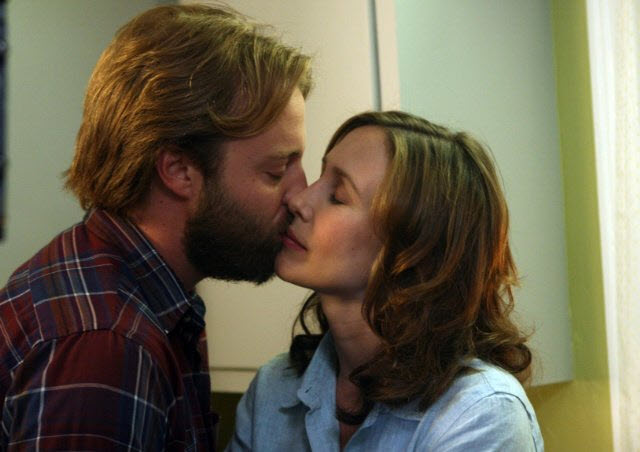
Jump forward to the 1970s, where Corinne becomes involved with a group of long-haired believers, often thought of in those day as “hippy Jesus freaks.” She begins a sexual relationship with Ethan (Joshua Leonard), a young musician she met through church. She also befriends Annika, a young lady in the congregation. Again, fast forward to see Corinne and Ethan married, with a baby on the way. Eventually, the couple has two daughters and a son.
Corinne’s close friend, Annika, becomes the one person with whom Corinne can be herself. The two frankly discuss their sex lives and Annika reveals some graphic drawings she made of her husband. In an interesting and possibly controversial twist, Annika often speaks in tongues, and Corinne is jealous of her friend’s ability. Corinne tries repeatedly to speak in tongues, praying fervently to the Holy Spirit to give her this gift.
The church Corinne and Ethan are part of throughout the film is small and tightly-knit. The love and support the members show each other, in general, is very sweet and well meaning, though it is sometimes flawed by misspoken words and poor advice. For instance, one lady in the congregation, adopting the role of the older woman as described by Paul in Titus 2:3-5, admonishes Corinne not to speak out in Bible Study, and to dress conservatively. The advice given, though biblical as written in 1 Timothy 2:9-15, takes on the appearance of self-righteousness. Because Corinne cannot see what she did wrong, she is very confused by the admonitions.
Annika is stricken with a life-threatening brain tumor, and Corinne and the rest of the church family support her completely, including a prayer vigil in the hallway of the hospital. Eventually, Annika is left disabled by the tumor and subsequent surgery. Annika’s husband, Ned, clearly living out Ephesians 5:25, is a devout man and faithful husband, and his devotion to Annika, despite her handicap, is an inspiration.
Eventually, due to the grief of Annika’s illness, Corinne begins to examine her life and marriage more deeply. She feels she is more educated and higher thinking than Ethan, and finds she looks down on his simple faith.
Because of Corinne’s frustration in her own faith, and the natural stress of raising children, Corinne and Ethan find their marriage struggling. They seek marital counseling, which is unnecessarily negative, and, although the words of the counselor are biblical, the effect on Corinne (and the audience) is exceedingly negative, and forgets the words of Jude 1:22 — “And have mercy on those who doubt.”
How can we know there’s a God? Answer
What if the cosmos is all that there is? Answer
How do we know the Bible is true? Answer
Right up until she leaves Ethan, Corinne begs God to guide her in making the decision. Perhaps like the words of James 1:5-6, Corinne is doubtful of God’s answer, because she finds God silent on the subject.
Following an amicable separation, Corinne becomes even more unsure of her beliefs. She remembers her childhood step of faith, years ago at the Vacation Bible School, and comments that she now feels nothing. As Corinne moves into a rooming house, once again the well-meaning advice she receives from her mother and her new neighbor contain derogatory comments about different races and faiths. They fail to remember John 8:15— “You judge according to the flesh; I judge no one.”
In the last scene of “Higher Ground,” Corinne admits to the other church members her struggle with her faith, that she wants God to feel at home in her heart, but doesn’t know how to make it real.
Was Yeats correct when he wrote that a person should not give the heart outright? Should we trust the truth of our faith, despite our sometimes negative emotions? Are happiness and fidelity in love and marriage based on feelings or the choices we make? These are all questions that cause Corinne’s struggle and with which we can empathize. We can cling to the words of Jesus in Matthew 22:37-39,
“You shall love the Lord your God with all your heart and with all your soul and with all your mind. This is the great and first commandment. And a second is like it: You shall love your neighbor as yourself.”
“Higher Ground” is an interesting movie for believers and non-believers alike, but beware it contains explicit language (including several f-words) and frank sexual content that many will find offensive. Despite its shortcomings, the film can invoke a lot of questions and thoughts about faith.
Violence: Minor / Profanity: Moderate / Sex/Nudity: Heavy
 What is a true born-again, eternally saved follower of Jesus Christ? Are you going to Heaven? Are you SURE you know the answer this extremely important question? Or have you made some common wrong assumptions? Find out now…
See list of Relevant Issues—questions-and-answers.


PLEASE share your observations and insights to be posted here.