Melancholia
 for some graphic nudity, sexual content and language.
Reviewed by: Thaisha Geiger
CONTRIBUTOR
| Moral Rating: | Very Offensive |
| Moviemaking Quality: |
|
| Primary Audience: | Adults |
| Genre: | Sci-Fi Drama |
| Length: | 2 hr. 10 min. |
| Year of Release: | 2011 |
| USA Release: |
November 11, 2011 (Los Angeles) November 18, 2011 DVD: March 13, 2012 |


end of the world disaster—no survivors
wealth
DEPRESSION—Are there biblical examples of depression and how to deal with it? Answer
What should a Christian do if overwhelmed with depression? Answer
FEAR, Anxiety and Worry—What does the Bible say? Answer
impending death
bride / marriage feasts / marriage
infidelity—adultery
SUICIDE—What does the Bible say? Answer
If a Christian commits suicide, will they go to Heaven? Answer
drug overdose
mounting family tensions mounting and fraying relationships
mother daughter relationship
father daughter relationship
sister sister relationship
| Featuring |
Kirsten Dunst … Justine Charlotte Gainsbourg … Claire Kiefer Sutherland … John John Hurt … Dexter Charlotte Rampling … Gaby Alexander Skarsgård (Alexander Skarsgard) … Michael Stellan Skarsgård … Jack Udo Kier … Wedding planner See all » |
| Director | Lars von Trier — “Dogville,” “Dancer in the Dark,” “Breaking the Waves” |
| Producer |
Zentropa Entertainments Memfis Film Zentropa International Sweden See all » |
| Distributor | Magnolia Pictures |
“It will change everything.”
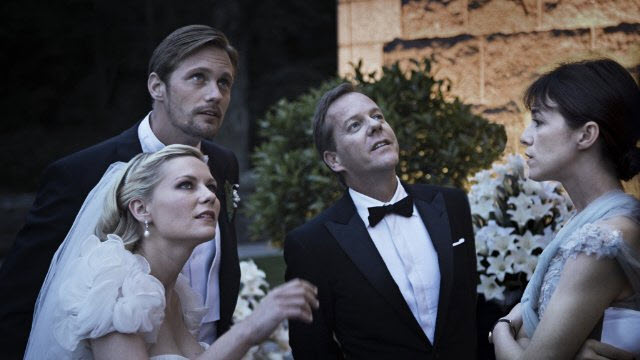
The first part of “Melancholia” begins with the wedding of Justine (Kirsten Dunst) and Michael (Alex Skarsgård). On their way to the reception, they appear happy, even though their limo is stuck on a dirt road, causing them to be late. Throughout the reception, it becomes clear that Justine begins to struggle with everyone’s expectations and the lack of love they provide for her.
The second part is from the point of view of Justine’s sister Claire (Charlotte Gainsbourg). Claire is seemingly more successful than Justine. She has one son, and her husband is wealthy. She also takes care of Justine when her sister hits one of her lowest points. Though secretly an anchor for her family, Claire becomes increasingly worried when the planet “Melancholia” keeps approaching Earth at a rapid pace. Though her husband tries to assure her of its projected safe path, Claire isn’t that confident that Melancholia will miss Earth.
“Melancholia” is different from other apocalyptic films. There are no jetfighters or massive worldwide chaos. More so, it attempts to analyze the inner human emotions when one knows the end is imminent. The film has a stunning opening sequence of slowly moving paintings which give away almost the entire plot. This is likely because Lars von Trier aimed for his newest film to be driven by art, rather than by plot. It’s a rather ambitious goal, making “Melancholia” a hit or miss. Surprisingly, I am somewhat in the middle.
The acting is solid. I believe this is Kirsten Dunst’s best performance to date. It was also nice to see the father-son collaboration of the Skarsgård actors.
“Melancholia” demonstrates the effects of depression: never fitting in, the happy charade, and trying to conform into the definition of normalcy. However, running at over two hours, the film’s pace is agonizingly slow. And after viewing the film and mentally scrutinizing the film’s many themes, I strongly disagreed with some of the film’s stances.
***Spoiler ahead*** The film claims that Justine “sees” things. What does she see, exactly? Well, this is up to the personal viewer. However, my take is that she realizes the futility of life, the meaningless of it all. Justine states that the Earth is evil, and no one will miss it. Since Melancholia’s collision will soon destroy Earth, Justine’s previous depression is morbidly matched and becomes justified. She strangely becomes at peace with her impending death. Ironically, once emotionally distraught, she becomes the pillar of the family, while Claire who had cherished her life, becomes frantic and bewildered. ***END SPOILER***
In the book of Ecclesiastes 1, King Solomon did write “everything is meaningless”. However, this is not in the same regard as Justine’s morbid, godless analysis. Rather, King Solomon viewed his life with great humility and with a great dose of reality. Riches and efforts into our perishable goals are indeed meaningless when they contribute nothing to our eternal salvation. Despite the brevity of our lives, God does want us to enjoy the fruits of our labor and see the beauty of life, his gift, to us. In Ecclesiastes 3, King Solomon wrote,
“What do workers gain from their toil? I have seen the burden God has laid on the human race. He has made everything beautiful in its time. He has also set eternity in the human heart; yet no one can fathom what God has done from beginning to end. I know that there is nothing better for people than to be happy and to do good while they live. That each of them may eat and drink, and find satisfaction in all their toil—this is the gift of God.”
Besides this pessimistic worldview, “Melancholia” is also rightfully rated “R”. In all, I counted about 10 uses of profanity: 4 f-words, 2 GDs, etc. A character commits suicide (off screen). Justine’s wedding dress is very low cut. With her husband, they share a few passionate kisses. At one time, she puts his hand underneath her dress, and in another, he takes off his pants. There is one brief, adulterous sex scene. While in her wedding dress, Justine pushes a man down and straddles him. He later comments that they had good sex.
There are two instances of nudity, but they are not sexual in nature. During the worst of her depression, Claire tries to bathe Justine. One can see Justine’s derriere and breasts as she struggles with Claire. In the second, Justine lies upon some rocks and stares up at Melancholia. This latter nude scene lasts a bit longer; the shot briefly shows her entire body from a distance, and then from her chest and up.
The film does have some intriguing themes interwoven throughout its run, even one about water. The execution and pacing ruined, for me, what could have been a much better film. While it does accurately show what depression symptoms could represent, Justine’s depression seemed to be derived from the hopeless despair she felt. I praise the Lord above that this world is not hopeless, nor is the Earth is evil. Life has beauty in it, and God is good. I recommend that Christians skip “Melancholia” entirely.
Violence: Mild / Profanity: Moderate / Sex/Nudity: Heavy
See list of Relevant Issues—questions-and-answers.
 Discover God’s promise for all people—explained beautifully and clearly from the beginning. Discover The HOPE! Watch it on-line, full-length motion picture.


PLEASE share your observations and insights to be posted here.
It’s not just acceptance at the end—but maybe she knows where she’s going, maybe she knows Leo is going with her, maybe she has shared the gospel with Claire and is looking at her hoping she has or will make the decision before it is too late.
And I have a Masters in theological studies. The Earth was not made evil, but “all creation groans”—the universe is now broken—broken is evil. Satan is the ruler of this present age. So she was right. It’s actually a Christian world view from a non Christian director. “The world is evil and nobody will miss it.” Mainly, maybe, because we will get a new heaven and a new Earth. The universe—when the Earth goes—I’m assuming it won’t be around long.
In fact it might already be gone in the movie, the only thing left in the universe might very well be Melancholia and the Earth. We can’t see anything else, God is light and in the end there will be light and maybe the Earth is protected from all the destruction that would have happened with an actual giant planet so close, and all that is left is the light of God reflected by Melancholia and Earth—and then poof.
Maybe the planet is only mistakenly thought of as a planet—maybe it’s not even that—something “other” something “God” heavens rolling up like a scroll. It’s not a Christian movie – but it is a movie from a director who has thought through theological issues, not accepted, but thought through.
It is one of my top three movies of all time. I deal with depression. I’m okay for one reason and one reason only – our Lord. God bless and keep you. And I just really wanted to let you know you were read, and enjoyed. For kids—a definite no to the movie. For adults, with the right Christian worldview behind us, there can be some good “pillaging of the Egyptians”.
My Ratings: Moral rating: Average / Moviemaking quality: 5