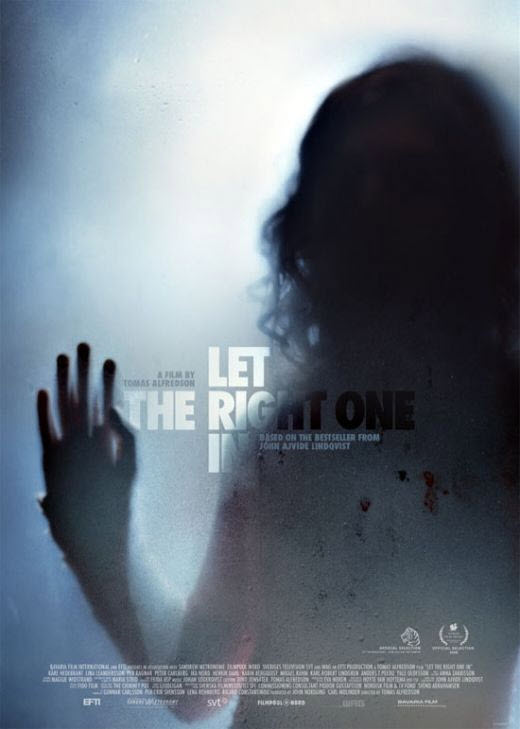
Let the Right One In
 for some bloody violence including disturbing images, brief nudity and language.
Reviewed by: Ben Tabberer
CONTRIBUTOR
| Moral Rating: | Very Offensive |
| Moviemaking Quality: |
|
| Primary Audience: | Adults |
| Genre: | Horror Thriller Romance Drama |
| Length: | 1 hr. 55 min. |
| Year of Release: | 2008 |
| USA Release: |
October 24, 2008 |




ETERNAL LIFE—What does the Bible say about it? Answer
eternal death in the Bible
sin and the fall of man
SELF-MUTILATION—Help for Cutters (and others who self-injure in some way)
REVENGE—Love replaces hatred—former israeli soldier and an ex-PLO fighter prove peace is possible-but only with Jesus
SUICIDE—What does the Bible say? Answer
If a Christian commits suicide, will they go to Heaven? Answer
GAY—What’s wrong with being gay? Answer
What about gays needs to change? Answer
It may not be what you think.
VIOLENCE—How does viewing violence in movies affect families? Answer
Every time you buy a movie ticket or rent a video you are casting a vote telling Hollywood “That’s what I want.” Why does Hollywood continue to promote immoral programming? Are YOU part of the problem? Answer
What is goodness?
FEAR and anxiety—What does the Bible say? Answer
How do I know what is right from wrong? Answer
How can I decide whether a particular activity is wrong? Answer
What advice do you have for new and growing Christians? Answer
| Featuring | Kåre Hedebrant (Oskar), Lina Leandersson (Eli), Per Ragnar, Henrik Dahl, Karin Bergquist, Peter Carlberg, Ika Nord, Mikael Rahm, Karl Robert Lindgren, See all » |
| Director |
Tomas Alfredson |
| Producer | EFTI, The Chimney Pot, Fido Film AB, Filmpool Nord, Ljudligan, Sandrew Metronome Distribution Sverige AB, See all » |
| Distributor | Magnet Releasing |
“Oscar, an overlooked and bullied boy, finds love and revenge through Eli, a beautiful but peculiar girl who turns out to be a vampire.”
Vampires are everywhere. You can see them in the bookstore: Stephenie Meyer’s Twilight saga and Rachel Caine’s Morganville series are currently being displayed in their own special interest sections nationwide. You can see them on the television: HBO’s “True Blood” and the BBC’s “Being Human” are keeping the genre alive on opposite sides of the Atlantic. But more than ever, you can see them at the cinema: “30 Days of Night,” “I Am Legend,” and “Twilight” have all enjoyed success at the box office and forthcoming features “Blood: The Last Vampire” and “Twilight: New Moon” are expected to do similar business. Much lower profile than these is Swedish independent film “Låt den rätte komma in” or to give it its English title “Let the Right One In.” Like “Twilight,” “I Am Legend” and “30 Days of Night,” “Let the Right One In” is adapted from a novel of the same name. The book, written by John Ajvide Lindqvist, became a bestseller in the author’s home country of Sweden and has gained cult status in the various countries for which it has been translated.
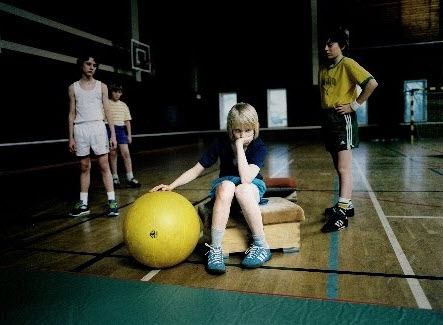
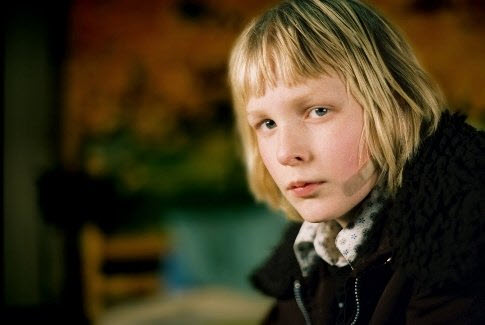
The film is set in 1980’s Stockholm, where snow covers the suburban council estate where Oskar, an introverted 12 year old boy, lives with his mother. Recently moved in to the flat next door with her elderly male guardian, is Eli, a curiously self-assured androgynous girl of the same age. Nightfall comes early this near to the Arctic Circle, and as Oskar and Eli are both accustomed to spending their respective evenings outdoors alone (Oskar due to his lack of friends and the neglect of his mother, Eli for more sinister reasons) the pair inevitably meet. A mutual interest develops between the two; they appear to find a sense of solidarity in there individual set of circumstances. Soon they start relaying Morse code messages to each other through the wall that separates the two flats. Before long, Eli learns that Oskar is being bullied at school, and advises him to stick up for himself by hitting the bullies back even harder than they hit him. If this doesn’t work, Eli informs Oskar that she will help him herself.
Meanwhile, dead bodies are being found throughout the town. Eli’s guardian, Hakan, has been hanging people upside down, cutting them open and draining their blood into a jimmy can which he later takes home for Eli. Except, he’s old and not as good at it as he once was and gets spooked during a typical draining forcing him to mutilate himself in a bid to protect his identity lest he be identified with the child he resides with. This forces Eli to take matters into her own hands, searching for her meals on the estate late at night, thus compromising her previous relative anonymity. As the body count intensifies, Oskar puts two and two together and confronts Eli over his suspicions that she might be a vampire.
Confirming his suspicions, she explains that she lives off human blood and has been 12 for a very long time. Seemingly undaunted by this admission, Oskar begins helping Eli, doing small favours for her to help ensure her survival. But as Eli’s hunger intensifies, so does the number of dead residents, thereby threatening her survival. Eli decides that her position on the estate has become unsustainable and says her last goodbyes to Oskar. Back at school, Oskar decides to follow Eli’s advice to stand up for himself, severely damages the ear of his chief tormentor, Conny. This sparks a conspiracy of revenge amongst the bullies that Oskar has little chance of escaping from, especially if Eli has left town…
For all its artistic merit, LTROI does have some extremely objectionable content. Aside from some brief language, there is one scene of replicated child nudity which, although clearly done with make-up and prosthetics, is nonetheless alarming and may well cause offence to a more conservative audience. This pales in comparison, however, to the horror exhibited in the film. While the film should be applauded for using the horror scenes sparingly, when they come, they are properly shocking. As a born-again believer with an unnaturally strong stomach for movie horror and gore, largely developed in my pre-salvation days, I have to admit at being taken aback at what I saw. There are two scenes in particular which I should mention. The first is when Eli’s guardian Hakan is forced to disfigure himself after being spooked just before draining a boy’s blood. This he achieves by pouring acid on his face, the aftermath of which is even more disturbing than when we first see Two Face in “The Dark Knight” movie. The next is near the film’s climax, which without wanting to give too much away, involves severed heads and limbs.
“Let the Right One In” deals with a number of issues, the chief of which is friendship. The relationship between Oskar and Eli is beautifully played between the two young actors as they find kinship and solidarity in the circumstances of each other’s lives. Oskar is, in a way, as much of a loner and an outcast as Eli, and they enjoy playing together as you would expect any pair of twelve year olds to do. They both appear to express genuine concern for the welfare of the other, going to extraordinary lengths to help each other. Their friendship transcends that of a pre-pubescent boyfriend and girlfriend and takes on a more platonic sense; Eli even informs Oskar that she is neither male nor female, to underline this point. The Bible speaks to us of the value of friendship, David and Jonathan being a prime example.
Another big theme is that of bullying. It is the fact that Oskar is being bullied that sparks feelings of sympathy in Eli, prompting her to take Oskar under her wing and try to toughen him up. Throughout the course of the film, we find out that in the night time hours, Eli has always been watching Oskar, witnessing his bullying and always ready to intervene should things get out of hand. It is in this respect that I was reminded of God’s promise to watch over and protect His people, made originally to the Israelite’s, but reiterated by Jesus in the Gospels. The popular verse of Psalm 23: “Even though I walk through the valley of the shadow of death. I fear no evil, for you are with me;” certainly struck a chord here. However, there is an important distinction to be made. While the Lord promises to protect and deliver His people, we are also commanded to turn the other cheek (Matthew 5:39; Luke 6:29); again we are told that those who live by the sword shall also die by it (Matthew 26:52). Therefore, Eli’s advice, although well-intentioned, is nonetheless incongruous with biblical teaching.
Another key theme is murder. There is no escaping the fact that Eli is a vampire and, as such, has to kill to stay alive. This is first achieved by way of her guardian, Hakan, who seems to pick his victims indiscriminately. When it is no longer possible for Hakan to continue, Eli takes matters into her own hands, but appears to be somewhat more selective in her choice of victims. Clearly, she had the choice to kill Oskar upon their first encounter, but there is never any hint that this may have been her intention. What is more, in one scene where Oskar in his naïveté suggests they become blood brothers, slitting his hand in the process, Eli warns him to leave before her thirst takes control. The victims Eli picks are largely down and outs, whoremongers and prostitutes, all of which are fully grown adults who appear to be past the age of 40. This seems to suggest that there is some kind of moral code in Eli’s selection process. However, no matter how and for what reason murder takes place, the Bible’s teachings on it are clear (Exodus 20:13), and no moral code can be applied that would make the sin in any way acceptable.
There are other relevant themes that are touched upon and alluded to throughout the film, such as suicide, prostitution and even paedophilia, but, for this reviewer, there was one theme that stayed with me long after I left the cinema: deception. As touched as I was by the relationship that developed between Oskar and Eli, I couldn’t stop thinking about something that was hinted at in the final scene. Without wishing to drop a spoiler, I would simply like to add that the ending is somewhat ambiguous, and, to that end, I may just be speculating. However, it is in my humble opinion that Oskar may have been the victim of deception in that he was manipulated by Eli throughout in order for her to serve a particular end. I will allow those who haven’t seen the film to form their own opinions, but suffice it to say that, if this view holds any water, then it casts the film in a rather darker light, if that is possible. We know that as followers of Christ, we face a powerful adversary in Satan whose modus opperandi is deception. If, therefore, the real horror of this film is that a relative innocent such as Oskar has been deceived, then what we have here is not a gothic tale of friendship, as is the case with the more palatable “Twilight,” but rather a cautionary tale about the pitfalls of deception, making it a far more terrifying proposition altogether.
I will leave that one up to you and welcome any comments on the matter. It should be said, however, that the moral ambiguity and even amorality of the film should in no way detract from its artistic integrity; this is independent cinema at its best. The Stockholm suburb is stark and beautifully shot, evoking a dark and chilling sense of mood and atmosphere. The performances from the largely young and unprofessional cast are surprisingly strong, especially in the case of the two leads. But most of all one feels that a real attempt has been made to dissect the vampire myth, approaching it with a genuine curiosity as to what resides in the psyche or even the soul of these mythical creatures of the night. This level of attention to detail has not been seen before in films of this genre, the most popular of which tend to glamorize what have traditionally been viewed as evil. For this reason “Let the Right One In” should be commended, and should rightly be considered as the final word in vampire movies.
Violence: Extreme / Profanity: Mild / Sex/Nudity: Moderate
See list of Relevant Issues—questions-and-answers, and reviews of other vampire movies.


They form an uneasy friendship and as their relationship grows, hideous mysteries are revealed and the walls appear to be closing in on the two misfits. If you shuddered at F. W. Murnau’s or Werner Herzog’s “Nosferatu,” and were chilled by Lugosi in Todd Browning’s “Dracula,” if you liked Peter Cushing battle Christopher Lee in the classic Hammer monster movies, if you were mystified by Guy Maddin’s delirium in “Dracula: Pages From the Virgin’s Diary,” and moreover if you were let down by Coppola’s “Dracula” or bored to tears with “Twilight” then get ready for a new and more pensive take on the vampire mythos.
There is plenty to be discussed about this film (the definition of real love and innocence is wrestled with in one of the most fascinating and graceful ways). I’m not going to lie to you. This is a film-person’s vampire movie and, yes, there is violence (and none of it is necessarily justified), but you enter into the world of the movie and you let it spin until it comes to its conclusion.
The violence itself is treated without glamour (I think movie violence should not be glamorized and made to seem “awesome,” but rather it SHOULD stir us and tweak our emotions). The questions raised by the two lead characters’ relationships has a lot of weight and things to discuss.
I encourage anyone with some patience and an open-mind to view this film (not for children, by the way, this IS rated R). Like many good movies, it may not offer specific answers, but it does bring up some important questions. I think you will enjoy this movie (but please take into account the R rated nature and subject matter, because this may not be your cup of tea). I enjoyed it very much and was bolstered to see a good vampire movie again and to see a film tackle issues of isolation, love, and revenge in an intelligent, respectful manner that does not insult its characters or audience.
My Ratings: Moral rating: Better than Average / Moviemaking quality: 4