
Caught Stealing
 for strong violent content, pervasive language, some sexuality/nudity and brief drug use.
Reviewed by: Jim O'Neill
CONTRIBUTOR
| Moral Rating: | Extremely Offensive |
| Moviemaking Quality: |
|
| Primary Audience: | Adults |
| Genre: | Crime Dark-Comedy Psychological-Thriller Adaptation |
| Length: | 1 hr. 47 min. |
| Year of Release: | 2025 |
| USA Release: |
August 29, 2025 (wide release—3,578 theaters) DVD: November 11, 2025 |
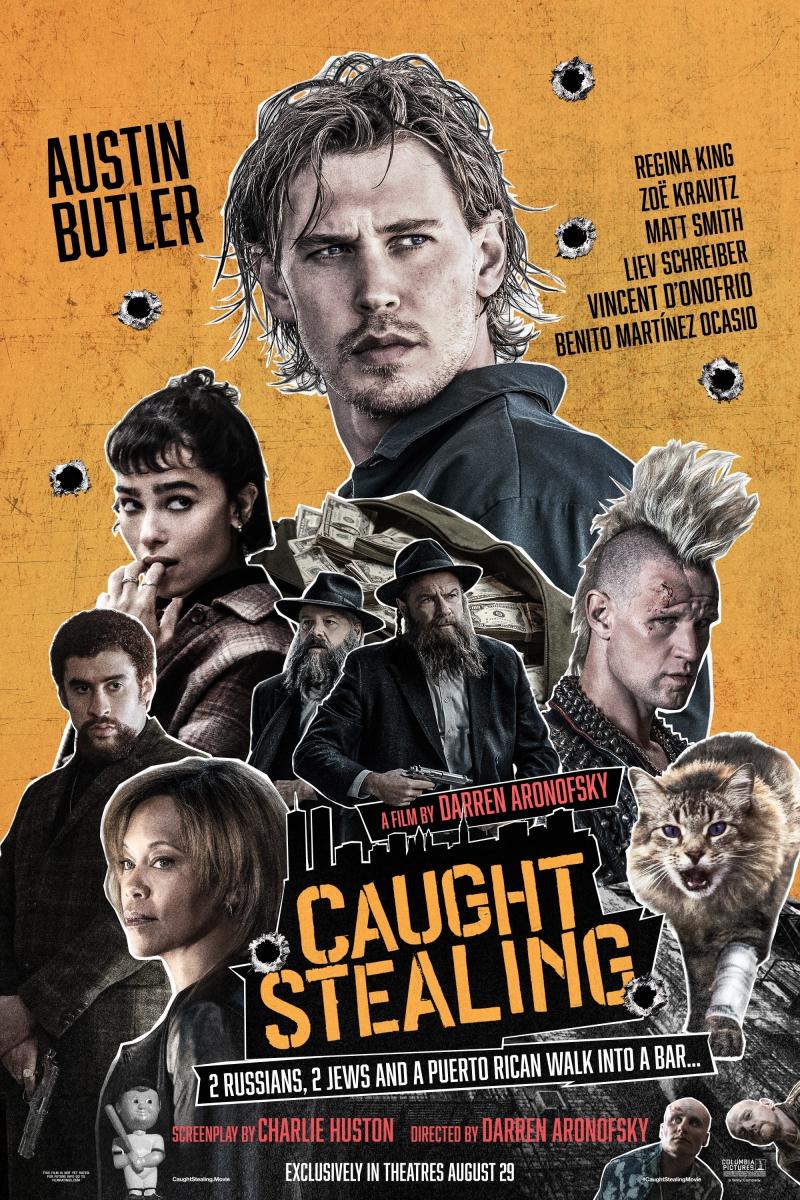



Setting: 1998 New York City criminal underworld
This film is an adaptation of the novel by Charlie Huston titled “Caught Stealing.” His stories often explore themes of morally complex characters navigating gritty, violent worlds, with a worldview skeptical of clear-cut moral or political absolutes. For example, his Henry Thompson trilogy delves into the struggles of an anti-hero caught in ethically questionable situations, reflecting on how individuals respond to violence and circumstance.
The film’s score was written and recorded by the English post-punk band Idles.
FILM VIOLENCE—How does viewing violence in movies affect families?
| Featuring |
|---|
|
Austin Butler … Henry “Hank” Thompson Bad Bunny … Colorado Zoë Kravitz … Yvonne Carol Kane … Bubbe Vincent D'Onofrio … Shmully Liev Schreiber … Lipa Matt Smith … Russ Regina King … Roman Griffin Dunne … Paul See all » |
| Director |
|
Darren Aronofsky |
| Producer |
|
Darren Aronofsky Jeremy Dawson See all » |
| Distributor |

“Small town boy. Big city problems.”
“When a man is getting better, he understands more and more clearly the evil that is still left in him. When a man is getting worse, he understands his own badness less and less.” —C.S. Lewis
“On the one hand, we’ll burn in hell; on the other, that’s a lot of money.” —Wall Street Journal cartoon by P. Byrnes
When I’m not working, I spend most of my time reading books and watching movies. Exciting, I know, but after a spate of sitting through violent movies and sifting through even more violent books, I find myself wondering at this late stage in my life if I should take a step back. I might do better looking toward more placid ways to spend my time. Maybe I should play mahjong, or if I do stick with reading and moviegoing, return to Agatha Christie or Louisa May Alcott, or replay old Vincent Minelli musicals or Douglas Sirk melodramas.
The ferocity of the twentieth century page and screen is not letting up, and it’s taking a toll. A couple of years ago on a friend’s recommendation, I took a shot at but was mowed down by Charlie Huston’s book Caught Stealing. I sped through the crime novel because it was twisty and fast-paced, and it reminded me of the caper masterworks I most admired, ones written by Lionel White, Edmund Alter and Dorothy Hughes. But Huston’s writing, though taught and terse, proved too much for me.
My friend had given me the three set Hank Thompson (Huston’s focal character) series, but after finishing “Caught Stealing” I couldn’t move onto the other two. The human and animal cruelty, the torture sequences (one of those went on for what I think was 25 pages), the police corruption clichés, and the alcohol-soaked atmosphere of the novel drained me. I was more relieved than released when I finally got to its blasé and derivative epilogue.
Huston has adapted his novel to the screen, and the film version is directed by Darren Aronofsky, a filmmaker I sometimes admire (“The Wrestler”), but mostly don’t. His movies, especially his last endeavor, “The Whale,” are as condescendingly boastful as they are morbidly nihilistic.
In transferring Huston’s novel to the screen, I wondered how he would shape Thompson’s misadventures into a tense thrill ride, a carousel of cruelty that ekes out enough of the benevolence that made the novel almost bearable. And how would Aronofsky offer the kind of deliverance that crime stories need, the assurance that our fallen world is ultimately redeemable? Doom seems to be the destiny of all of Aronofsky’s subjects, and Hank, as naïve and misguided as he tends to be, does manage to climb his way back up out of every drain pipe he spirals down. He is hardly a good fit for the director’s dim view of human potential and salvation.
And would Aronofsky spare us the novel’s graphic and unpalatable depictions of a cat’s broken leg, Hank’s attempts to splint the leg and treat the cat’s pain with narcotics, his own beating by head butts, belly kicks and brass knuckle punches that lead to a loss of a kidney, and his bout of incontinence (yes, both kinds) that becomes a major plot device?
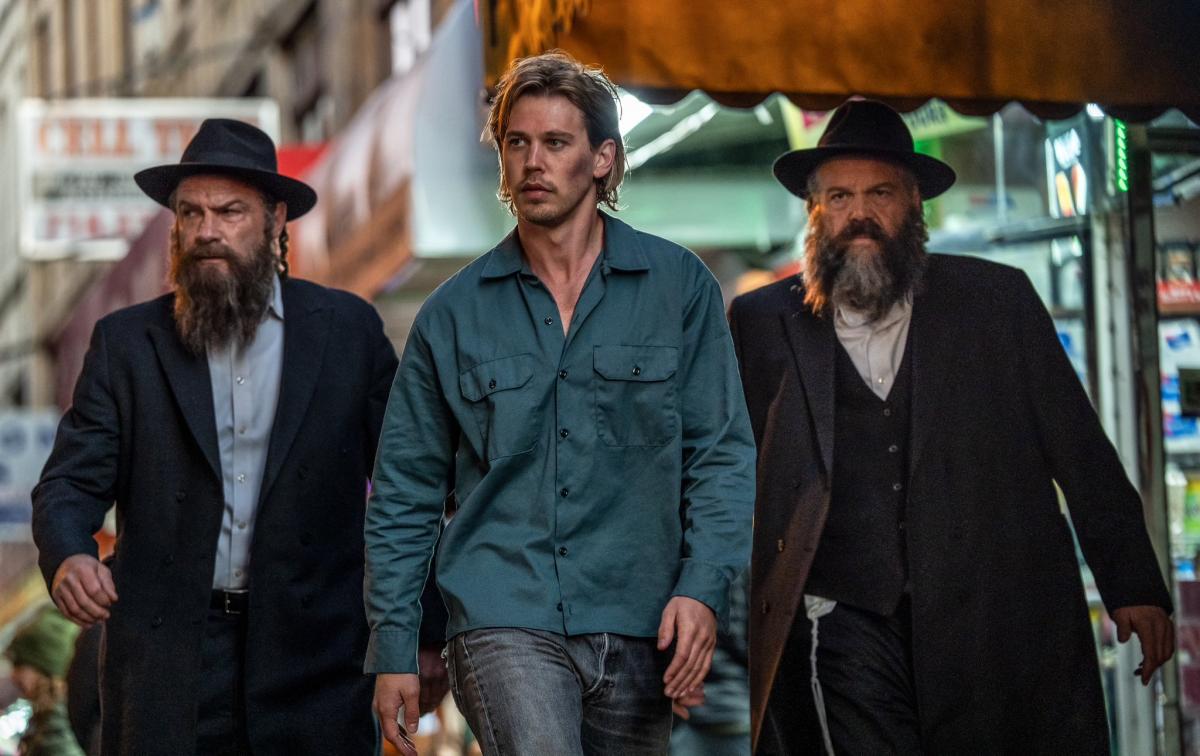
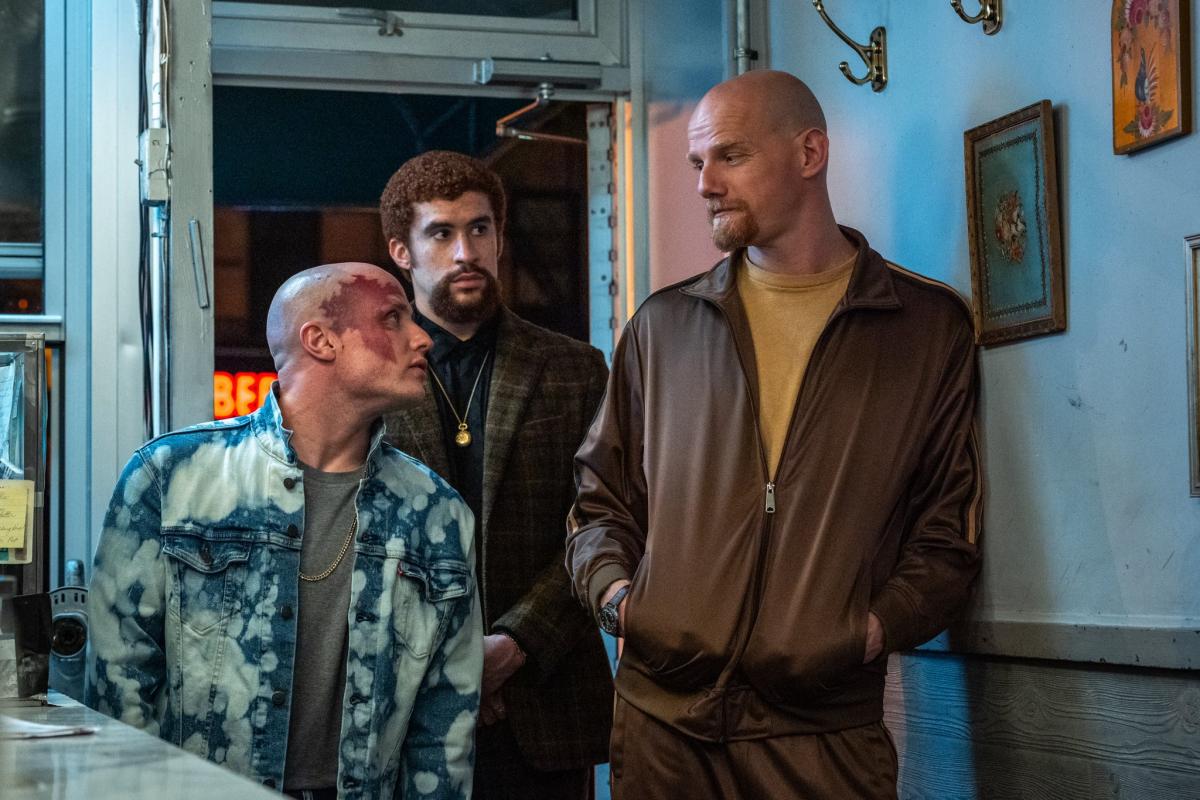
I’m not giving away any spoilers when I say Aronofsky does spare us most of those stomach turners. What he replaced them with, however, makes for a heist adventure that is implausible, unfettered and ultimately daft. The baddies are as two dimensional as the villains in a cheap graphic novel, despite some adept comic performances by Liev Schreiber and Vincent D'Onofrio who appear as religiously observant but morally inert members of a Jewish crime syndicate.
Aronofsky, or the Sony-Columbia execs backing the movie, changed the villains in the book to types that fit a more woke worldview: an Hispanic immigrant is softened with sympathetic touches while Hasidic Jews and Putin-resembling Russians are given the Snidely Whiplash treatment. It’s an easy out for the filmmakers, but an inane pander that quickly goes from woke to wonky. The actors seem to know they are being asked to do one-dimensional skits of slapstick shysters and so they play their parts mostly for laughs.
Sadly, their high jinks never come off and turn as soggy as the matzo ball soup their grandmother (Carol Kane in a wince inducing cameo) serves for a Jewish holy feast.
Regina King, usually a compassionate and engaging actress, plays the investigating cop, a part so badly adapted as to be unconvincing and at times ludicrous. King has one good scene in which she contrasts the reality of a city life she wants to escape with a dream of someplace over the rainbow. The only thing she will miss is New York’s trademark black and white cookie. If she gave her lines and her accent as much attention as she does to her dessert, she might have taken us somewhere. Hers was the most difficult character to bring off, an up and down arc that an actress of her caliber should revel in and bring home. But she uncharacteristically, and at times embarrassingly, misses that mark.
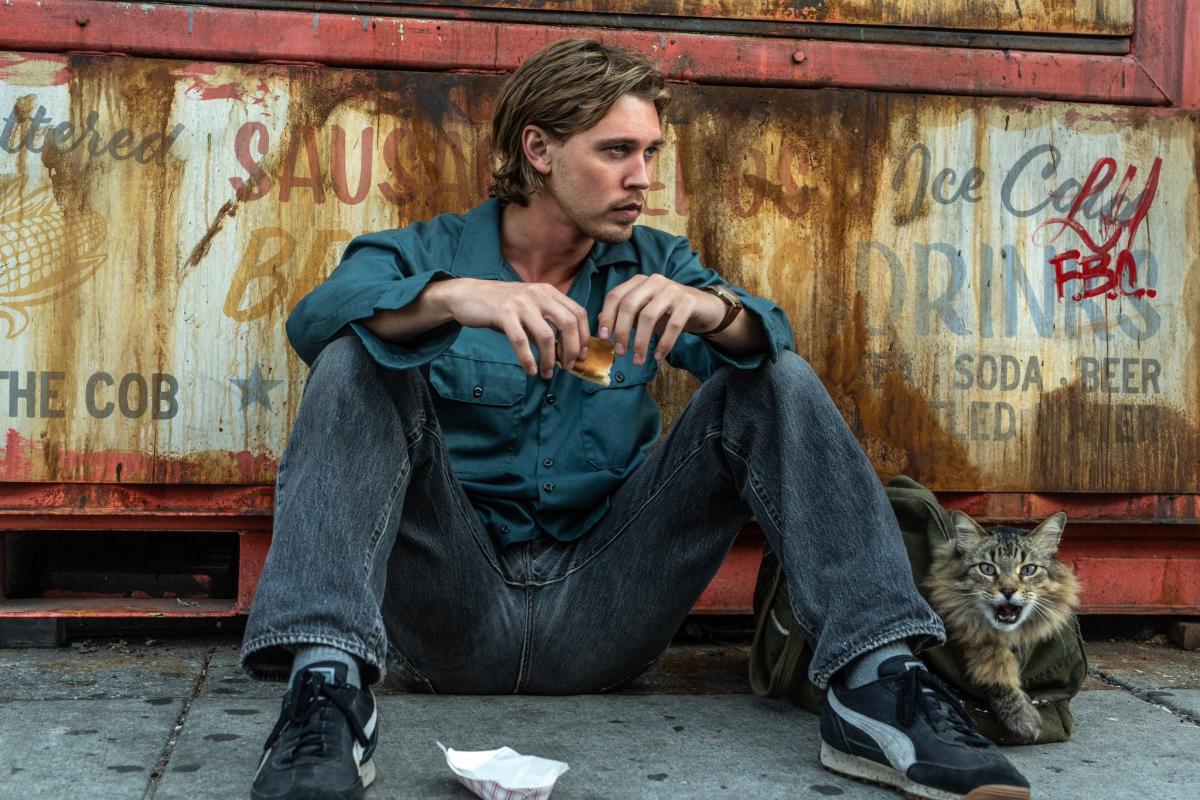
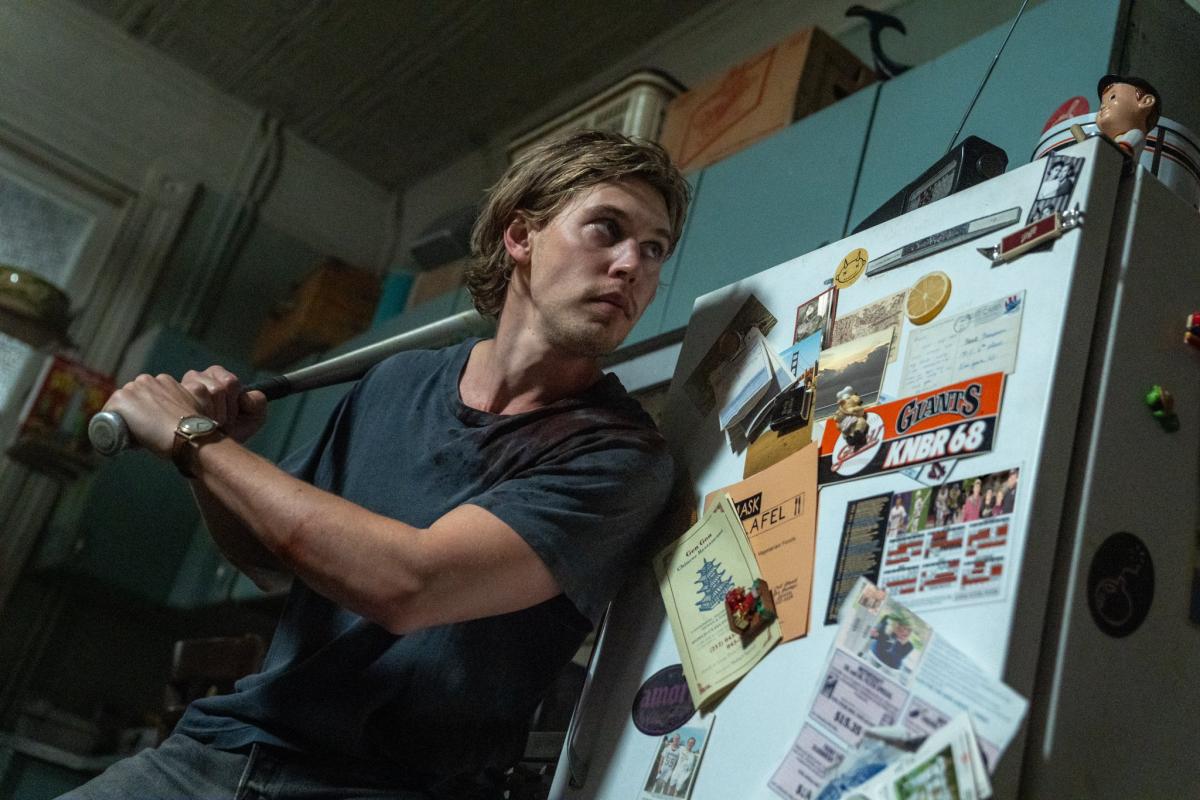
Hank Thompson, played by Austin Butler with his usual gritty charisma, was a former high school baseball player who had hopes of a major league career until he irreversibly injured his knee in a car accident, a smash-up that kills his passenger friend and ends his own dreams of baseball glory.
Ten years later, he moves from California to New York City and works as a bartender in an East Village dive owned by a straggler (Griffin Dunne) who launders his money in the establishment’s basement.
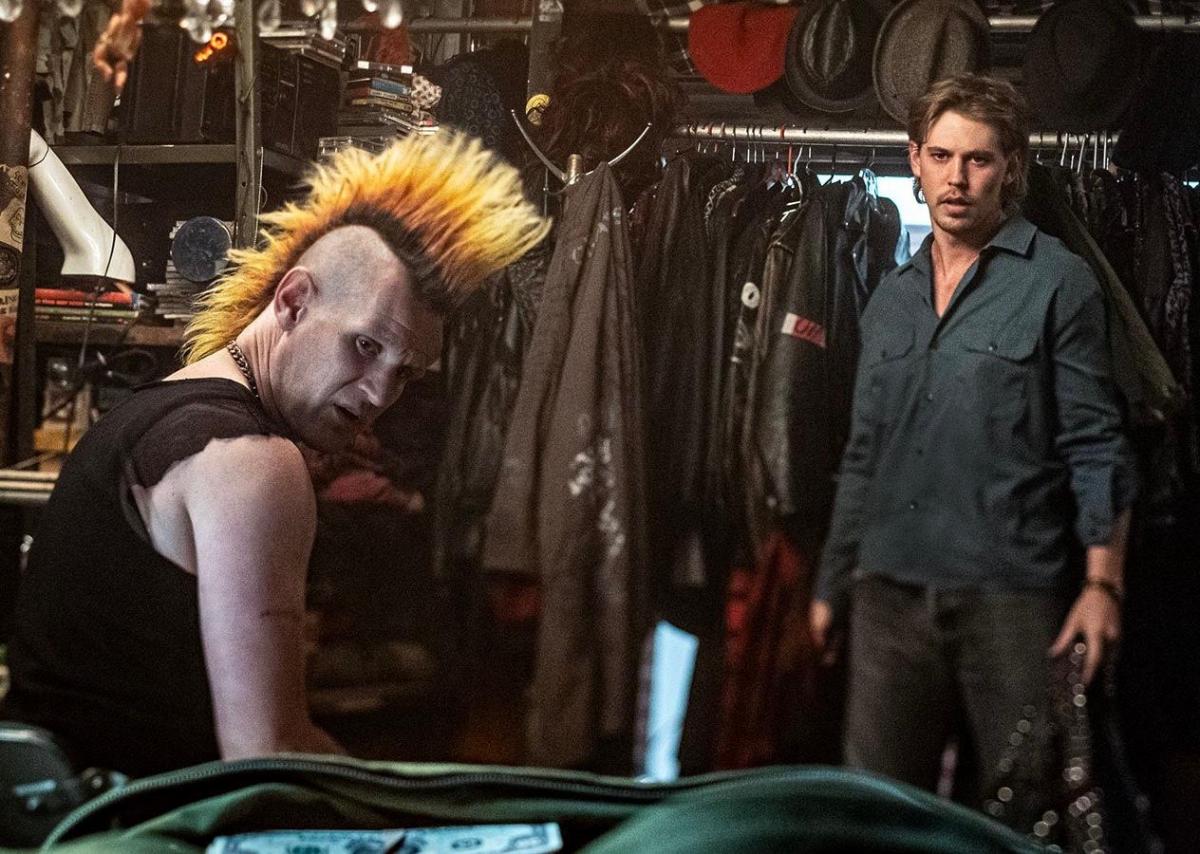
Hank lives in a nearby walk-up across the hall from his neighbor, Russ (Matt Smith, in a spiked hairdo that distracts from what has become Smith’s trademark pierce of a stare). Russ asks Hank to take care of his pet cat, Bud, while he is away in London visiting his dying father. Concealed in Bud’s litter box is a key that unlocks a door to a storage locker that holds a stash of ill-gotten money.
A panoply of crooks on both sides of the law is in pursuit of Hank and that stash, but they need the key to open the treasure chest. Therein lies the catalyst for the ensuing action which consists mostly of pursuits down apartment building hallways, across fruit markets, through subway cars, and along Flushing Meadows Park in Queens. It amounts to an awful lot of running, jumping and pedaling to the metal for a guy who suffered a severe knee injury and a recent kidney removal.
There are some fun 1990s New York City cityscape scenes, but they’re mostly travelogue fillers with none of the emotional undercurrents of crime dramas that employed the city as an actual character: “Night of the Juggler,” “Mean Streets,” “Mixed Blood,” “The Taking of Pelham One Two Three.” Those classics, all made in the 70s, make you feel the city’s pulse, grit and danger and give you the sense that a fate like Sodom and Gomorrah’s or Nineveh’s without Jonah was at hand.
Aronofsky’s city imagery feels remote and intangible, a playground of social decay that has forgotten its roots and lost its desire for renewal and rebirth. New York was beginning to improve its lot during the 1990s, the movie’s timeframe, but that betterment is barely alluded to, and then mockingly.
Hank’s love interest, like most of his encounters, is a one and done affair, with Zoë Kravitz struggling in what is yet another underwritten part. She makes the most of what constitutes banal throwaway dialog: She: “I need you to take advantage of my poor judgment.” He: “I depend upon your poor judgment.”
The would-be romance between Hank and girlfriend Yvonne brings some heart and pathos to the story and slows it down a bit. Both are night owls, he the late shift bartender; she, an emergency medical technician, something that comes in handy when Hank is beaten to such a pulp that his recent surgical wounds open and ooze blood. She can re-suture them but sadly cannot stitch up a relationship fueled by equal parts danger and despair.
Huston and Aronofsky, both formula breakers in their respective fields, have proven themselves this year’s most formulaic movie development team. All the bones of a crime caper are present, but there’s no flesh on those bones and a spirit never takes shape.
The film has more sensitivity than fortitude, striving for manners more than perceptive. It succeeds in being inoffensive because the antagonists are members of easy-to-attack subgroups, but as a crime drama, it runs out of steam and ends up creeping along like a roller coaster in need of repair. The ride may be escapist, breath-halting and brisk, but the exit is a letdown that leaves a taste as cloying as the cotton candy eaten just before.
In today’s movies we have moved beyond the “do the crime, do the time” ethos. Bad guys are, we are told, good guys who make bad choices. C.S. Lewis said that “badness is only spoiled goodness,” meaning that evil is a perversion of the good, a promise that bread can be made from stone, that materialism itself is a virtue. Modern cinema continues to follow the “Godfather” motto that one can break the fifth commandment if it’s for the good of the family.
Alas, one of the most prescient lines in “Caught Stealing” is an instruction to Hank on how to fire a gun: “Just pull the trigger. It’s the easiest thing in the world.”
I recently re-watched S. Craig Zahler’s 2019 film, “Dragged Across Concrete” about two policemen played by Mel Gibson and Vince Vaughn, who become embroiled in a criminal enterprise that goes badly. The message of Zahler’s film is a departure from most crime dramas in that it employs a slow pace, sometimes achingly slow, to build a tension that is unyielding and unforgiving. Nothing that happens is expected and no one is spared a consequence of what they do. The film does not coddle us; it reminds us that without suffering and surrender there is no salvation. Pulling a trigger is never easy.
“Caught Stealing” gives us a hero who in the end rises like a phoenix from the ashes, but it’s a stilted rise. He has chosen a life amidst those ashes, has set fires that lead to more ashes, and has tread over the debris as he walks away. And doesn’t bother to sweep up after himself.
“There is no faithfulness, no love, no acknowledgment of God in the land. There is only cursing, lying and murder, stealing and adultery; they break all bounds, and blood follows bloodshed. Because of this, the land dries up, and all who live in it waste away…”. —Hosea 4
- Vulgar/Crude language: Extreme — F-words (about 150, very frequent), S-words (2 dozen+), C-word (6), A**, A**hole, B*tch, P*ss, Tw*t, and more
- Violence: Very Heavy
- Drugs/Alcohol: Very Heavy — cocaine snorting, smoking, alcohol abuse, drug dialogs
- Nudity: Heavy — bare breasts, see through bra, naked man (not full frontal), lingering view of woman’s scantily clad buttocks, scenes with women in revealing clothing and people in their underwear
- Sex: Moderate — raunchy hook up scene
- Profane language: Moderate — G*d, G*d d*mn
- Wokeism: Moderate
- Occult: None
See list of Relevant Issues—questions-and-answers.

PLEASE share your observations and insights to be posted here.