What is the…
City of David
Hebrew: עיר דוד —transliteration: Ir David
This is the name of 2 biblical cities, both strongly associated with the life of King David.
-
City of David, the oldest part of Jerusalem, Israel
Jerusalem’s ancient City of David—satellite viewDavid took the fortress of Mount Zion from Jebusites . “Then David lived in the stronghold; therefore it was called the city of David” (1 Chronicles 11:7).
This is the name afterwards given to the castle and royal palace on Mount Zion, as distinguished from Jerusalem generally (1 Kings 3:1; 8:1).
It is on the southwest side of Jerusalem, opposite the so-called temple mount, with which it was connected by a bridge over the Tyropoeon valley.
The exact location of the City of David was lost for centuries after the total Roman destruction of Jerusalem in 70 AD when surviving Jews were banned from the Jerusalem.
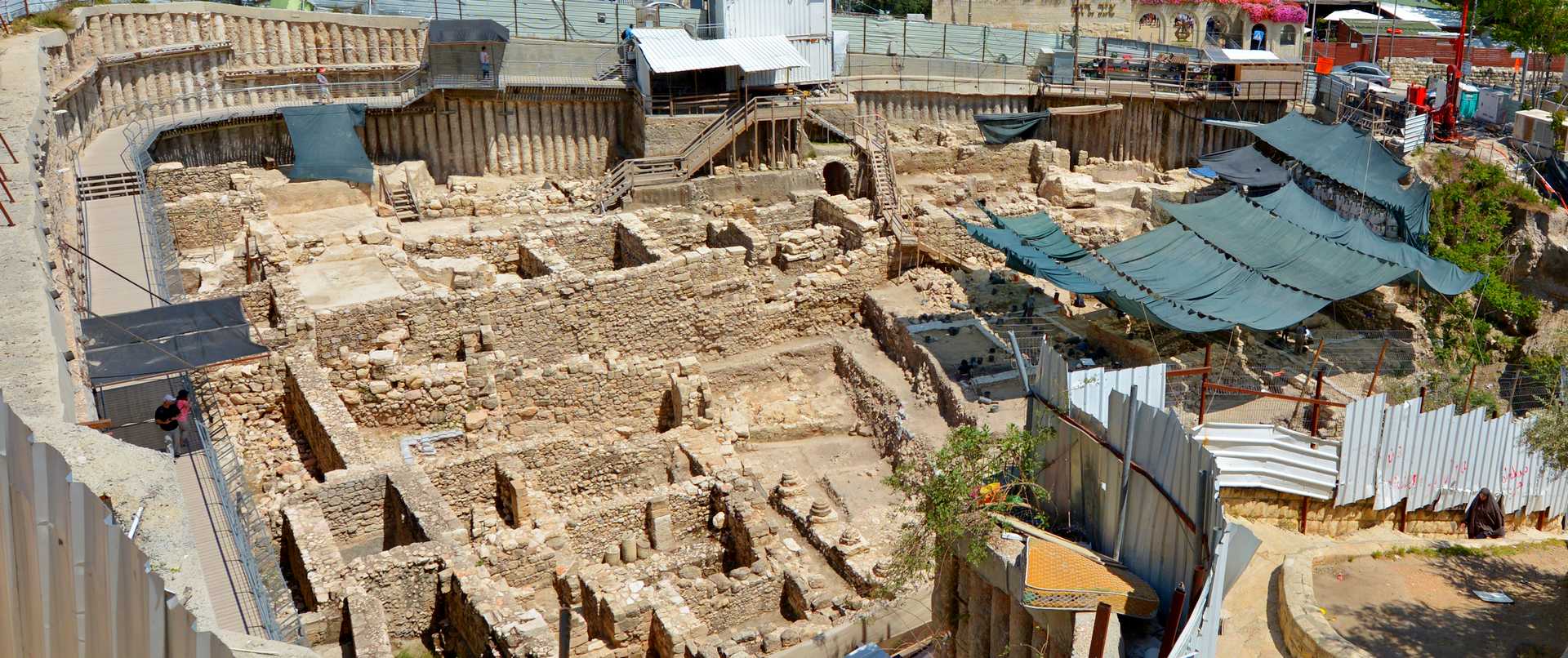
Archaeology of Jerusalem’s City of David
The City of David was rediscovered by archaeologists beginning in 1860, with excavations continuing to this day. The site is now a very important Israeli national park.
3D model of the City of David’s fortifications and David’s PalaceMuch has been uncovered here (partial list)…
- Canaanite fortress
- seal that mentions the city of Bethlehem, writen in ancient Hebrew script (Solomon’s Temple period)
- possible palace of King David—massive foundations and a structure that seems to date to the time of King David and appears to be remains of a palace, although there is some dispute
- King Hezekiah’s tunnel
- numerous clay seals found bearing Hebrew names
- a very large fortress surrounding the Gihon Spring with underground passages
- a tower that was part of the city walls in the days of Nehemiah (The Second Temple period)
- gold bell with an attached loop (The Second Temple period)—probably was sewn on a garment worn by a high Jerusalem official
- stone etching of a Jewish menorah
- Pool of Siloam (aka Shiloah Pool) (The Second Temple period)
- sections of the main road of the City of David (The Second Temple period)
- a major water channel beneath the above road (The Second Temple period)
Video: Discovery of an ancient water channel at City of David- a large residential building “that may have been part of the royal property of Queen Helene, a queen that converted to Judaism and lived in the city during that time period” (end of The Second Temple period)
- a Herodian road from Shiloah Pool to the Western Wall (Herod’s Temple period)
- a seal with the Aramaic words “Daka Le’Ya” (Pure for God), apparently the official seal used by Temple officials approving the purity of a sacrifice or object
- numerous finds “testifying to the days of the revolt against the Romans and the subsequent destruction of Jerusalem” / many artifacts from Jews hiding from the Romans during the city’s destruction (70 AD)
Q & A -
City of David, in the hill country of Judah
also known as: Bethlehem and Ephratah, etc.
Bethlehem, the City of David and birthplace of Jesus, the Christ, in fulfillment of ancient messianic prophecies. When King Herod heard that a “King of the Jews” was born in Bethlehem, he ordered the murder of all boys under age two. Bethlehem is currently a city with a Muslim majority—satellite view • scroll north or zoom out to see Jerusalem, about 6 miles (10 km) awayThis Bethlehem is called the “city of David” in Luke 2:4, 11, because it was David’s birthplace, early home and the place of his holy anointing by God through the Prophet Samuel (1 Samuel 16:1-13 LSB).
And Yahweh said, “Arise, anoint him, for this is he.” Then Samuel took the horn of oil and anointed him in the midst of his brothers; and the Spirit of Yahweh came mightily upon David from that day forward. —1 Samuel 16:13 LSB
More information
 What are horns in the Bible, and their uses?
- What is annointing?
- Answers about oils and ointments of the Bible and their uses
- What is Ephratah (Ephrath)?
- List of Messianic Prophecies fulfilled by Jesus Christ
- Who is Rachel, whose ancient tomb is believed to be in this Bethlehem?
- Answers about places called Bethlehem in the Bible
 What are the CITIES OF THE BIBLE? Names, descriptions, locations and types
Q & A
- Who is David? and why is he very important? /ul>