
What is…
Corinth
Corinth is a Grecian city, on the isthmus which joins the Peloponnesus to the mainland of Greece. It is about 48 miles west of Athens.
The ancient city was destroyed by the Romans (146 BC), and so the Corinth as mentioned in the New Testament was quite a new city, having been rebuilt about a century afterwards and peopled by a colony of freedmen from Rome.
Under the Romans, it became the seat of government for Southern Greece or Achaia (Acts 18:12-16).
It was noted for its wealth, and for the luxurious and immoral and vicious habits of the people. It had a large mixed population of Romans, Greeks, and Jews.
Corinth's biblical importance
- It was a major commercial and cultural hub (sin city of ancient world)
- Paul founded a church there (Acts 18)
- Paul wrote 1 & 2 Corinthians to that church
- Key issues addressed were:
- division (unity, we are one body)
- order in worship
- sexual immorality and purity
- authentic repentance
- wisdom of God versus worldly wisdom
- lawsuits
- idolatry
- food sacrificed to idols (liberty and conscience)
- spiritual gifts and their proper use
- love as greatest virtue
- marriage and singleness
- resurrection of the dead
- spiritual warfare
- comfort in affliction
- loving support for Christians in need
- etc.
- Corinth was central to Early Church development and the revealing of Christian theology
When the Apostle Paul first visited the city (51 or 52 AD), Gallio, the brother of Seneca, was proconsul.
Here Paul resided for 18 months (18:1-18). Here he first became aquainted with Aquila and Priscilla, and soon after his departure Apollos came to it from Ephesus.
After an interval, Paul visited it a second time, and remained for 3 months.
And there he spent three months, and when a plot was formed against him by the Jews as he was about to set sail for Syria, he decided to return through Macedonia. —Acts 20:3
During this 2nd visit, his Epistle to the Romans was written (probably 55 AD). Although there were many Jewish converts at Corinth, yet the Gentile element prevailed in the church there.
Some have argued from 2 Corinthians 12:14; 13:1, that Paul visited Corinth a 3rd time (i.e., that on some unrecorded occasion he visited the city between what are usually called the 1st and 2nd visits).
Here for this third time I am ready to come to you, and I will not be a burden to you; for I do not seek what is yours, but you. For children ought not to save up for their parents, but parents for their children. —2 Corinthians 12:14
But the passages referred to only indicate Paul’s intention to visit Corinth (compare 1 Corinthians 16:5, where the Greek present tense denotes an intention), an intention which was in some way frustrated. We can hardly suppose that such a visit could have been made by the Apostle without more distinct reference to it.
More information
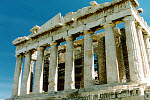 Answers about Ancient Greece in the Bible
- Who is Paul? and what is his significance?
- What is the 1st Epistle to the Corinthians?
- What is the 2nd Epistle to the Corinthians?
- Who is Aquila?
- Who is Priscilla?
- Who is Apollos?
- What are Grecians?
 Answers about Athens, Greece and the Bible
- Answers about the Greek language in the Bible
 What are the CITIES OF THE BIBLE? Names, descriptions, locations and types
- What is The Church according to the Bible?