After the Hunt
 for language and some sexual content.
Reviewed by: Jim O'Neill
CONTRIBUTOR
| Moral Rating: | Extremely Offensive |
| Moviemaking Quality: |
|
| Primary Audience: | Adults |
| Genre: | Crime Psychological-Thriller |
| Length: | 2 hr. 19 min. |
| Year of Release: | 2025 |
| USA Release: |
October 10, 2025 (wide release) |


Sexual abuse accusation against a university professor

Elite campus in turmoil
Morality, ethics
Are we living in a moral stone age?
Mentor protégée relationship
Plagiarism
What about Gays needs to change? —It may not be what you think.
Why is our level of humility important to God?
What is lying? What are the truly BIG lies of our world?
| Featuring |
|---|
|
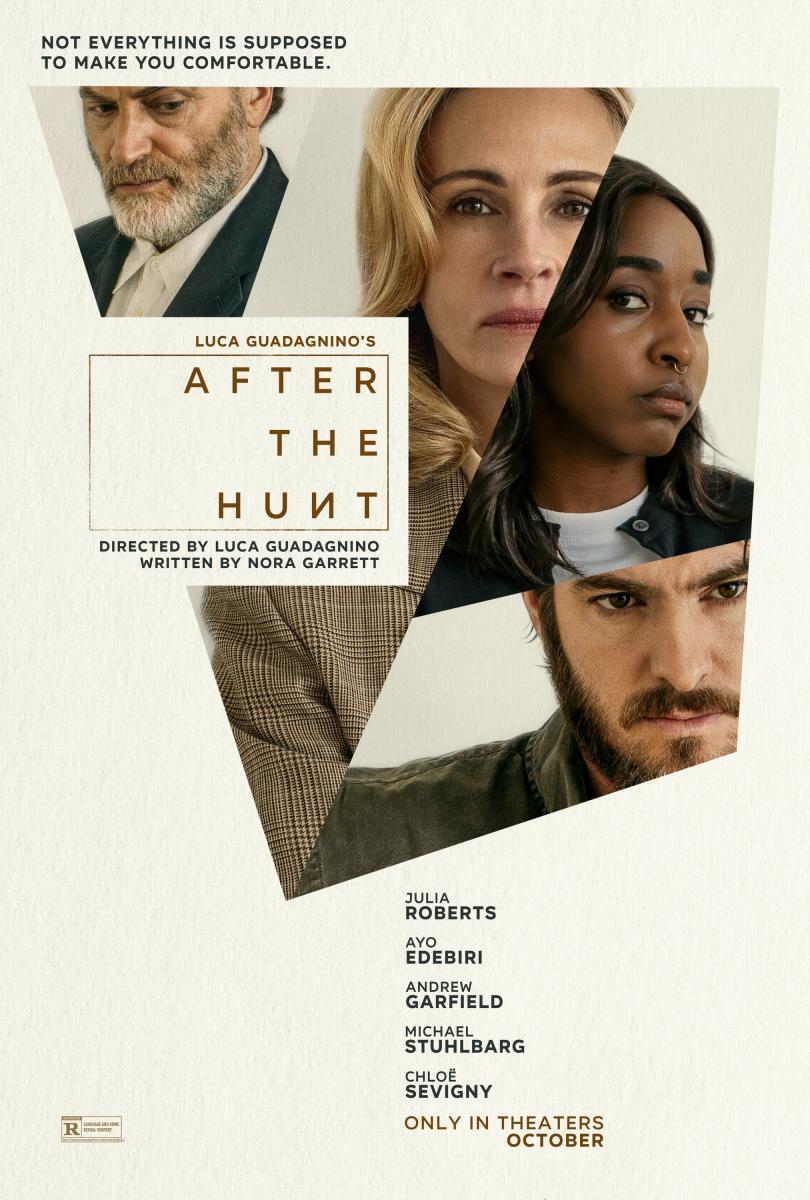
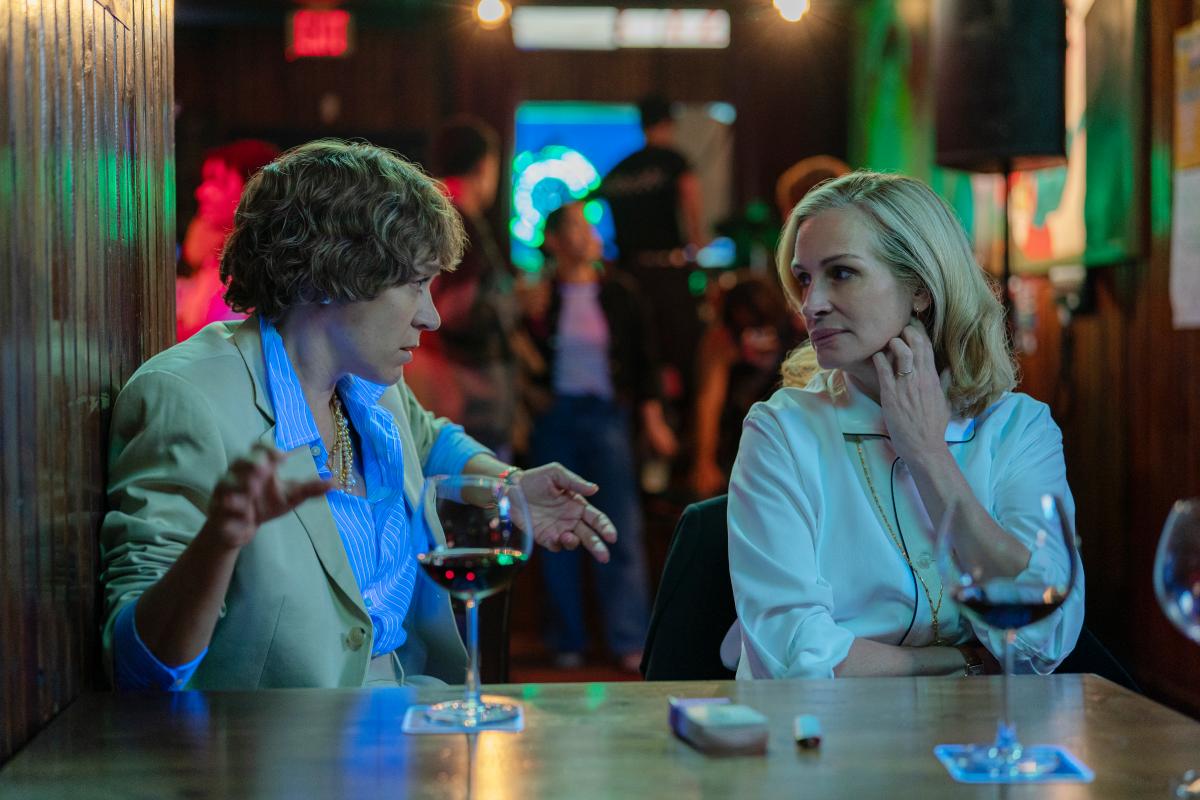
Julia Roberts … Alma Imhoff —a well-liked philosophy professor at Yale University Ayo Edebiri … Margaret “Maggie” Resnick —a young philosophy student and Alma’s protégée Andrew Garfield … Henrik “Hank” Gibson —Alma’s colleague and close friend who is accused of assault Michael Stuhlbarg … Frederik Imhoff —Alma’s psychiatrist husband Chloë Sevigny … Dr. Kim Sayers —the university’s student liaison and Alma’s friend See all » |
| Director |
|
Luca Guadagnino |
| Producer |
|
Big Indie Pictures Frenesy Film Company [Italy] Imagine Entertainment See all » |
| Distributor |

“There are six things the Lord hates, seven that are detestable to him: haughty eyes, a lying tongue, hands that shed innocent blood, a heart that devises wicked schemes, feet that are quick to rush to evil, a false witness who pours out lies, and a person who stirs up controversy in a community.” —Proverbs 6:16-19 NIV
“The truth is rarely pure, and never simple.” —Oscar Wilde, “The Importance of Being Earnest”
“In a time of deceit, telling the truth is a revolutionary act.” —George Orwell
Director Luca Guadagnino opens his film “After the Hunt” with Woody Allen-like black and white credits and headache-inducing ticks from an unseen clock. I braced myself for an Ingmar Bergman psychodrama rip-off, but shrugged off that idea thinking Guardagnino would instead go tongue-in-cheek and cast a satiric eye on his examination of college campus culture. He does neither. He spends most of the film’s more than two hour running time casting glances and looking away.
The film’s introductory scene at a faculty/student dinner party introduces us to all four of the film’s main characters. The dynamics and tics of their relationships quickly unfold. Each is completely at ease in the well-heeled, well-bred and to-the-manner-born environment in which they find themselves. No one speaks of tuition debt or financial struggle. Their verbal exchanges are as lofty as they are murky, starting with toss-off name-dropping (Foucault, Hegel, Heidegger) and trailing off into banter about patriarchal power structures and cisgender oppression.
It’s no wonder these highbrows keep reaching for fine-etched crystal glasses full of single malt scotch in between their sermonettes. I don’t condone heavy drinking on screen, but I can’t blame this bevy of clackers for seeking the nearest escape hatch.
The opening that takes place in a gilded faculty apartment is also key to a seamy story about a group of people who have something to hide beneath a nicely manicured façade. The set-up is classic Jean Renoir or Luis Bunuel, or even Woody Allen, minus, well, the everything. It’s one big Mona Lisa’s smile, if you believe as I sometimes do, that behind the lady’s ambiguous grin, there may lie nothing at all.
The apartment sets the movie’s tone. Its state-of-the-art kitchen, well-appointed and strategically hung artwork, and perfectly upholstered sofas all pose as cover for a sagging foundation. The stars are aligned for a perfect faculty/student get-together, although something is off: one of the bathrooms doesn’t work, while the other is poorly equipped and hiding a secret that is key to the drama.
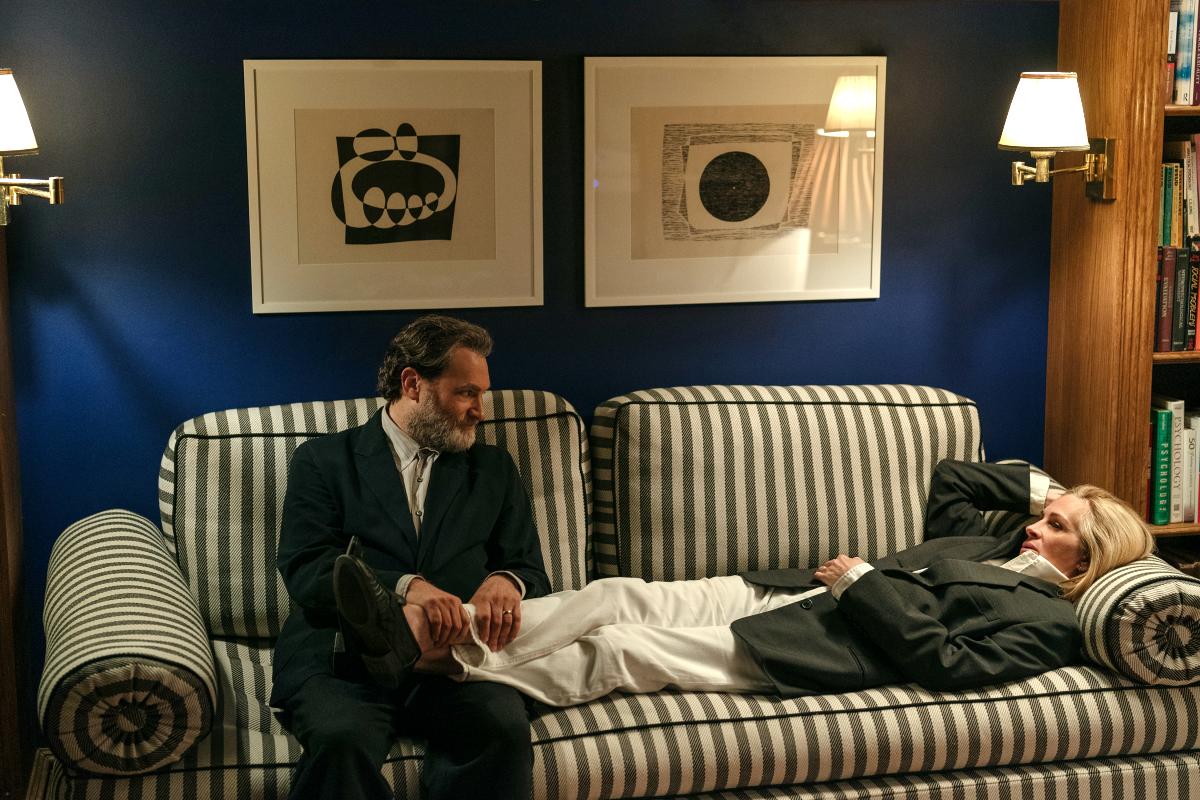
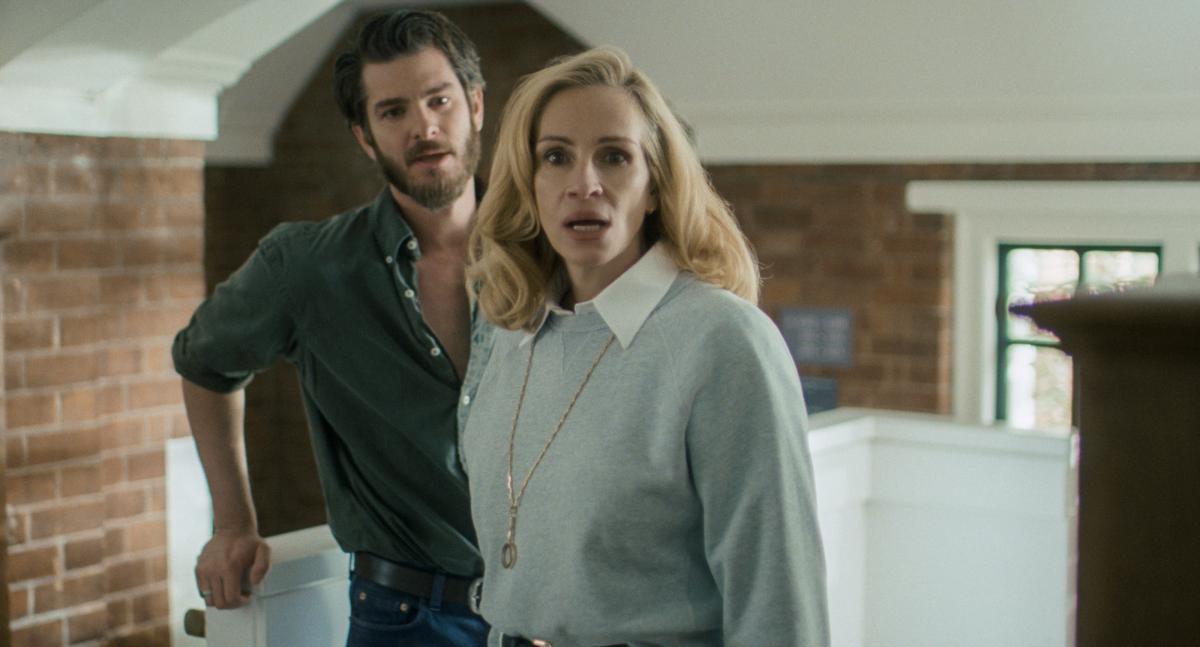
Professor Alma Imhoff (Julia Roberts) shares the abode with her psychiatrist husband, Frederick (Michael Stuhlbarg). Theirs is a comfortable marriage, although there are as many tears in its seams as there are in the apartment’s Laura Ashley-style fabrics. She is a popular philosophy professor who is on what seems to be an easy tenure track. She has a secure home life, but she may or may not be faithful to her husband and has alcohol and drug dependency issues which could be contributing to what appears to be a debilitating health condition.
Frederick is more doctor-type than doctor-man: he oozes compassion, understanding and empathy at every turn. He even cooks comfort food dinners for his wife. Granted, it’s cassolette, a sophisticated French kind of comfort food, but they do eat it on the kitchen island and not in the fancy dining room. Yes, they do come down to earth. Sometimes. He supports his spouse without reservation, although some repressed anxieties do find their outlets: he plays discordant rock and atonal John Adams opera arias loud enough to burst an eardrum, and watches porn on his computer while falling asleep in his marriage bed.
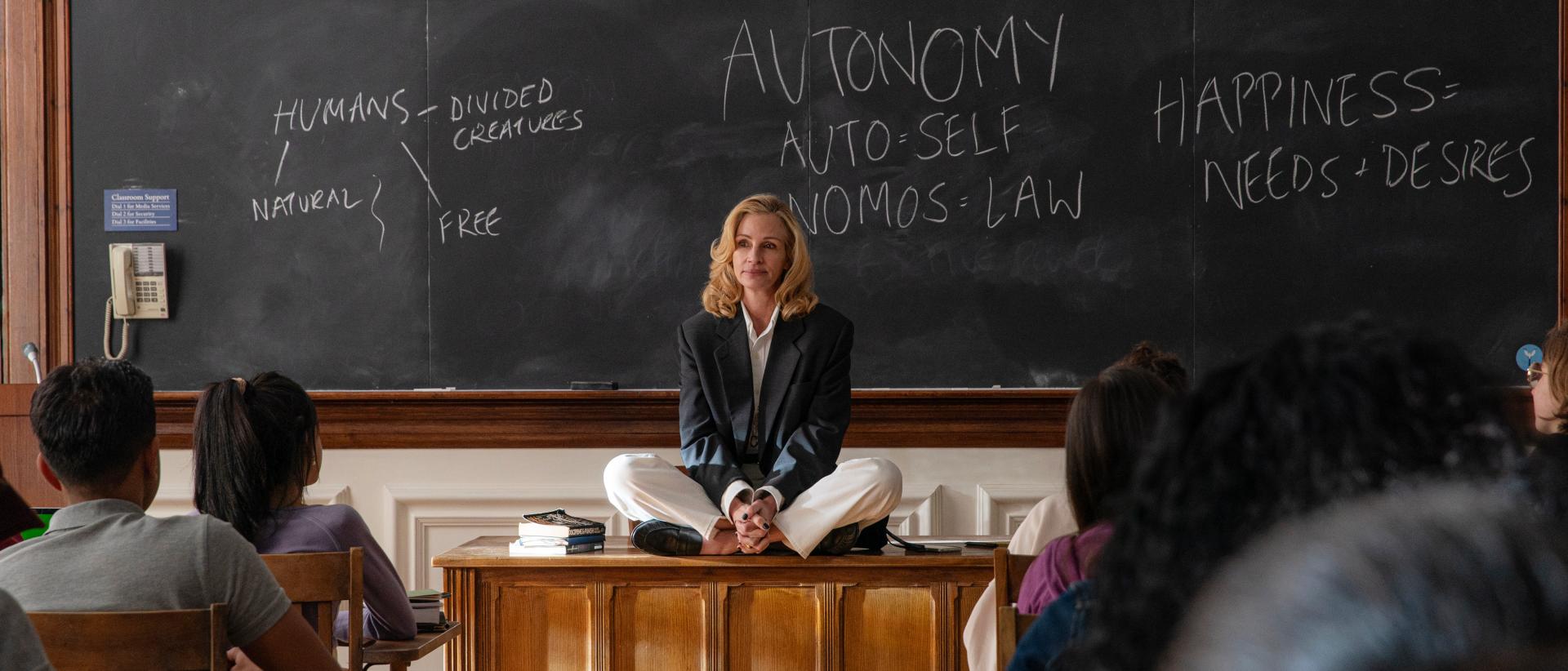
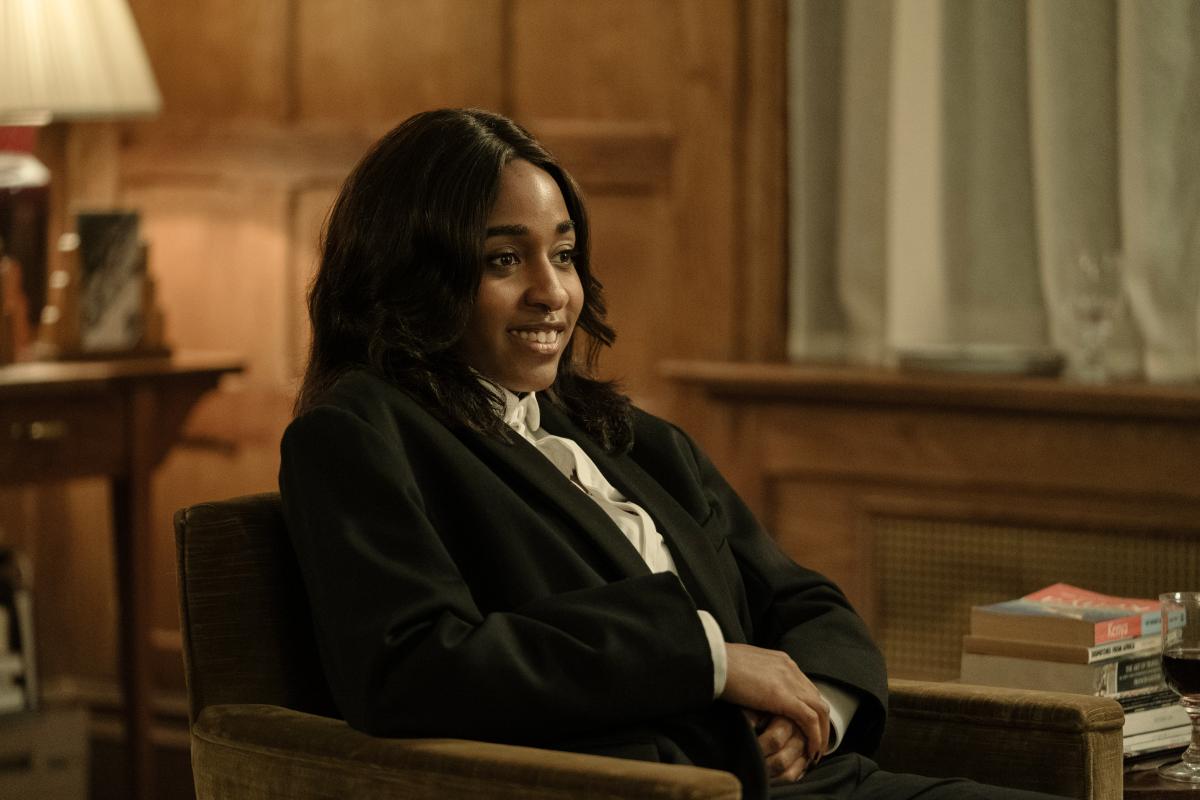
Alma has a special relationship with one of her students, Maggie (Ayo Edebiri), a doctoral degree student who is wealthy (her parents are major donors to the university), black, and homosexual. She is in a relationship with a post-surgical female-to-male transgender law student, and yes, we are treated to a visual of her thoracic disfigurement.
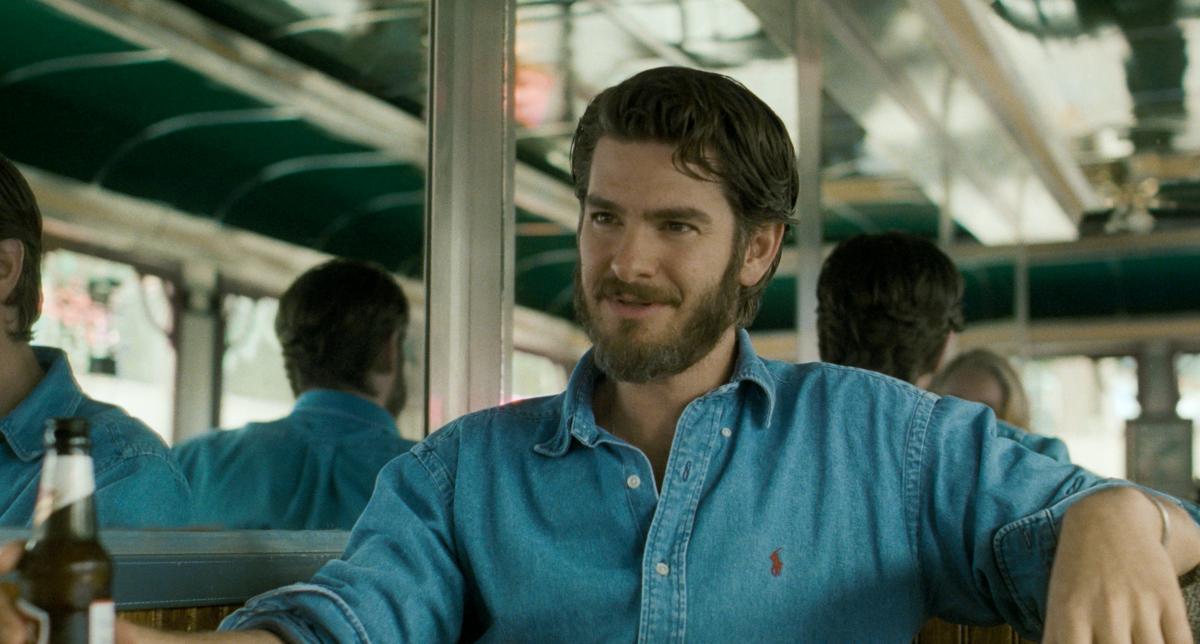
Maggie is, according to the professors who know her well, a mediocre student, a manipulator and a plagiarizer. Why so many of the rest of the faculty, including Alma, find Maggie engaging and sometimes “brilliant” remains a mystery, even after she threatens their comfortable perches by making a charge of sexual assault against another philosophy professor. The accused teacher, Henrik (Hank) Gibson (Andrew Garfield) is a friend of Alma’s and possibly a former lover.
Alma keeps a separate apartment, more like a den, in a bad part of town which Hank has a key to, shows up at, and seems to be quite at home in. No mention is made of possible former liaisons between the two or of why exactly Alma maintains the lair, other than it seems to have a liquor store within walking distance. The entire scenario proves sordid and senseless. It’s sordid because it’s a setting that acknowledges Alma’s lack of self-worth (whatever would Foucault make of such surrender to oppression by decrying one’s own “police state” while hiding inside of it?) and senseless because the overtly masculine, carnal and impulsive Hank is a most unlikely foil. He hardly seems Alma’s type or any kind of type one would see sipping coffee in a modern-day Ivy League faculty lounge. Hank is more suited to being a bodice-ripping horseman from a romance novel than to a bookish, high-minded, “publish or perish” philosophy professor. Even going by the nickname “Hank” instead of by his more distinguished given name “Henrik” would seem a bit off-the-grid for someone seeking by-lines and tenure.
Maggie, the accuser, is more annoying than fearsome. She is unable to formulate an argument or a point of view that is in any way coherent. Her word salads fail her completely when she is asked to re-cap important details of her alleged assault—such as places, timelines, and names of witnesses. She offers no whos, what’s or wheres, only uhs, ya-knows and felt-likes.
The film adds to the sham by shaping a world where the truth takes a back seat to a “no single truth, but each one’s own truth” world. It’s a murky space where reality turns fungible, vaporous, and ultimately untenable, more suited to pulling apart taffy than to chipping away at stone. Maggie discovers Alma’s secret backstory, the details of which are concealed in an envelope in the bathroom of the film’s opening scene, and she steals that evidence. Those skeletons are ultimately exposed, but when they are, there is too much fat left on the bones for their revelations to shine even a bit of light onto either woman’s conflict. We get a climactic surprise, but no resolution. And worse, no justice.
Julia Roberts would seem a good choice to play the part of Alma. A charismatic, authentic actress, she knows how to connect with an audience. Both men and women can relate to her, sympathize with her, and share her struggles. She is a welcome relief from the discordant, argumentative personae of recent failed films, most notably the haughty-eyed feminist denunciators Cate Blanchett in “Tar” and Carey Mulligan in “She Said.”
Roberts takes watery material (the script is by Nora Garrett) to tsunami heights in lines reflective of the Margo Channing—Eve Harrington exchanges in “All About Eve”: “You watch me! You study me!” or when she delivers the few burning ripostes that the script allows her: “Don’t you have some obscure protest to be publicly angry at?” or “Not everything is supposed to make you comfortable.” In those rare moments her signature smile goes from heartwarming to scalding, and the effect is exhilarating. Roberts elevates the film, takes it from the basement to the ground floor making it at times watchable, but doesn’t quite reach the mezzanine where she could give us a panoramic view, and an actual vision. The screenwriter, the director and the star can’t maneuver the tightrope between serious societal critique and good old Hollywood trashiness, a balance that Roberts did manage with her pitch-perfect performance in “Erin Brockovitch.”
“After the Hunt” has met with controversy since its summer premier at the Venice Film Festival. Accused of “making statements” and “ginning up controversy” about the MeToo movement, Roberts responded to a crowd of contentious journalists, most of whom were no doubt lodged comfortably in Lido beach hotels: “We are challenging people to have a conversation.” Granted, having conversations is a good thing, but to do so, we need to start the talk with a question and a premise. Garrett and Guardagnino provide us with neither. Instead, they hand us a microcosm of people who do bad things for bad reasons but stop short of analyzing their actions or assessing the consequences of their choices.
The heroine commits several ghastly crimes and yet concludes that she has come through her ordeal and is now “happy.” And so is almost everyone else in this ill-tasting brew. They lie, they steal, they covet, all while fancying themselves as moral exemplars and intrepid combatants in modern-day cultural warfare. “After the Hunt” sounds a lot of alarms but dons no armor and abandons its battle stations.
But the film’ greatest negligence is its inability or unwillingness to seek the truth. There is no Daniel-style wisdom to break down and uncover the veracity of an accusation. Susanna would stand no chance in front of these faculty elders. Then again, no one in Guardagnino’s film “feared the Lord” or “walked in obedience” to Him. They put their faith in their own truth: “if it’s real to you, it’s real,” and deprived themselves of the one truth that could set them free.
Q & A
Films can tell stories that teach us what lying to ourselves can do and what the wages of sin have always been without hitting us over the head with a mallet. When one chooses a path that is dark and laden with forbidden fruit, in the end he finds out where that road leads: to Hitchcock’s Bates Motel, to Welles’ burning mansion basement or to Visconti’s abandoned Lido Beach. We see it, we feel it, and despite what Foucault and Guardagnino may tell us, we get it. A conversation engages and even amuses. But it’s beside the point.
- Wokeism: Extreme
- Profane language: Very Heavy
- Vulgar/Crude language: Very Heavy
- Violence: Moderate
- Drugs/Alcohol: Very Heavy
- Nudity: Moderate
- Sex: Moderate
- Occult: None
See list of Relevant Issues—questions-and-answers.

PLEASE share your observations and insights to be posted here.