
Godly or evil? Who is…
Nimrod
also known as: Gilgamesh
by Bible archaeologist Dr. David P. Livingston, Associates for Bible Research
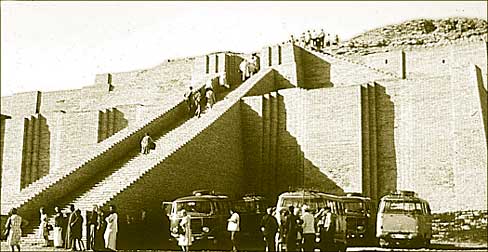
Nimrod revealed
The Bible states…
Cush was the father of Nimrod, who grew to be a mighty warrior on the Earth. He was a mighty hunter before the LORD; that is why it is said, “Like Nimrod, a mighty hunter before the LORD.” The centers of his kingdom were Babylon, Erech, Akkad and Calneh in Shinar. —Genesis 10:8-10 KJV
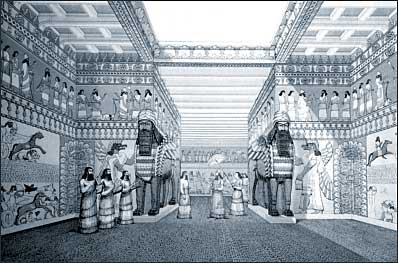
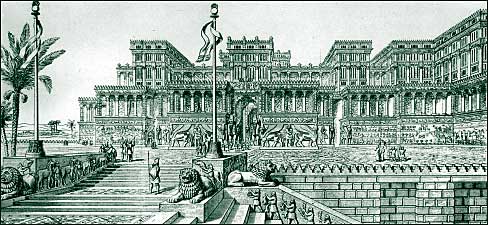
Many consider this to be a positive, complimentary testimony about Nimrod. It is just the opposite! First, a little background study is necessary.
Cultural Connections in the Ancient Near East
Besides the stories of the Creation and Flood in the Bible there ought to be similar stories on clay tablets found in the cultures near and around the true believers. These tablets may have a reaction, or twisted version, in their accounts of the Creation and Flood.
In the post-Flood genealogical records of Genesis 10 we note that the sons of Ham were: Cush, Mizraim, Put and Canaan. Mizraim became the Egyptians. No one is sure where Put went to live. And it is obvious who the Canaanites were. Cush lived in the “land of Shinar” which most scholars consider to be Sumer. There developed the first civilization after the Flood. The sons of Shem-the Semites-were also mixed, to some extent, with the Sumerians.
We suggest that Sumerian Kish, the first city established in Mesopotamia after the Flood, took its name from the man known in the Bible as Cush.
The first kingdom established after the Flood was Kish, and the name “Kish” appears often on clay tablets. The early post-Flood Sumerian king lists (not found in the Bible) say that “kingship descended from heaven to Kish” after the Flood. (The Hebrew name “Cush,” much later, was moved to present-day Ethiopia as migrations took place from Mesopotamia to other places.)
The Sumerians, very early, developed a religio-politico state which was extremely binding on all who lived in it (except for the rulers, who were a law unto themselves). This system was to influence the Ancient Near East for over 3000 years. Other cultures which followed the Sumerian system were Accad, Babylon, Assyria, and Persia, which became the basis of Greece and Rome’s system of rule. Founded by Cush, the Sumerians were very important historically and Biblically.
 Persia (Iran)—What is its significance in the Bible?
 What is the city of Babylon (Babel)? and what is its significance?
- What is the Kingdom of Babylon (aka Babylonian Empire)?
- Answers about Ancient Rome in the Bible
Was “Nimrod” Godly or Evil?
First, what does the name Nimrod mean? It comes from the Hebrew verb marad, meaning “rebel.” Adding an “n” before the “m” it becomes an infinitive construct, “Nimrod.” (see Kautzsch 1910: 137 2b, also BDB 1962: 597). The meaning then is “The Rebel.” Thus “Nimrod” may not be the character’s name at all. It is more likely a derisive term of a type, a representative, of a system that is epitomized in rebellion against the Creator, the one true God. Rebellion began soon after the Flood as civilizations were restored. At that time this person became very prominent.
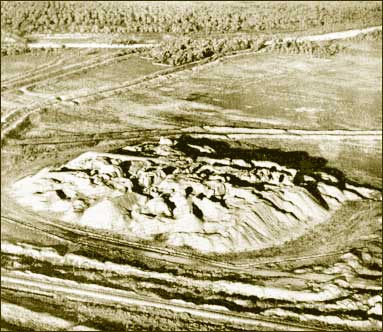
In Genesis 10:8-11 we learn that “Nimrod” established a kingdom. Therefore, one would expect to find also, in the literature of the ancient Near East, a person who was a type, or example, for other people to follow. And there was. It is a well-known tale, common in Sumerian literature, of a man who fits the description. In addition to the Sumerians, the Babylonians wrote about this person; the Assyrians likewise; and the Hittites. Even in Israel, tablets have been found with this man’s name on them. He was obviously the most popular hero in the Ancient Near East.
The Gilgamesh Epic
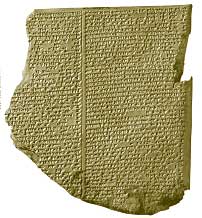
The person we are referring to found in extra-Biblical literature was Gilgamesh. The first clay tablets naming him were found among the ruins of the temple library of the god Nabu (Biblical Nebo) and the palace library of Ashurbanipal in Nineveh. Many others have been found since in a number of excavations. The author of the best treatise on the Gilgamesh Epic says,
The date of the composition of the Gilgamesh Epic can therefore be fixed at about 2000 BC. But the material contained on these tablets is undoubtedly much older, as we can infer from the mere fact that the epic consists of numerous originally independent episodes, which, of course, did not spring into existence at the time of the composition of our poem but must have been current long before they were compiled and woven together to form our epic (Alexander Heidel, 1963: 15).
Yet his arrogance, ruthlessness and depravity were a subject of grave concern for the citizens of Uruk (his kingdom). They complained to the great god Anu, and Anu instructed the goddess Aruru to create another wild ox, a double of Gilgamesh, who would challenge him and distract his mind from the warrior’s daughter and the noblemen’s spouse, whom it appears he would not leave in peace (Roux 1966: 114).
The Epic of Gilgamesh has some very indecent sections. Alexander Heidel, first translator of the epic, had the decency to translate the vilest parts into Latin. Spieser, however, gave it to us “straight” (Pritchard 1955: 72).
With this kind of literature in the palace, who needs pornography? Gilgamesh was a vile, filthy man. Yet the myth says of him that he was “2/3 god and 1/3 man.”
Gilgamesh is Nimrod
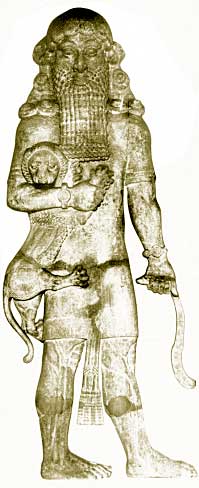
How does Gilgamesh compare with “Nimrod?” Ancient historian Josephus says of Nimrod,
Now it was Nimrod who excited them to such an affront and contempt of God. He was the grandson of Ham, the son of Noah-a bold man, and of great strength of hand. He persuaded them not to ascribe it to God, as if it were through his means they were happy, but to believe that it was their own courage which procured that happiness. He also gradually changed the government into tyranny-seeing no other way of turning men from the fear of God, but to bring them into a constant dependence upon his own power.
He also said he would be revenged on God, if he should have a mind to drown the world again; for that he would build a tower too high for the waters to be able to reach! and that he would avenge himself on God for destroying their forefathers! (Ant. I: iv: 2)
What Josephus says here is precisely what is found in the Gilgamesh epics. Gilgamesh set up tyranny, he opposed YHWH and did his utmost to get people to forsake Him.
Two of the premiere commentators on the Bible in Hebrew have this to say about Genesis 10:9,
Nimrod was mighty in hunting, and that in opposition to YHWH; not ‘before YHWH’ in the sense of according to the will and purpose of YHWH, still less,… in a simply superlative sense… The name itself, ‘Nimrod’ from Marad [aka Marda], ‘We will revolt,’ points to some violent resistance to God… Nimrod as a mighty hunter founded a powerful kingdom; and the founding of this kingdom is shown by the verb with consecutive to have been the consequence or result of his strength in hunting, so that hunting was intimately connected with the establishing of the kingdom. Hence, if the expression ‘a mighty hunter’ relates primarily to hunting in the literal sense, we must add to the literal meaning the figurative signification of a ‘hunter of men’ (a trapper of men by stratagem and force); Nimrod the hunter became a tyrant, a powerful hunter of men (Keil and Delitzsch 1975: 165).
“in the face of YHWH” can only mean ‘in defiance of YHWH’ as Josephus and the Targums understand it (op. citation: 166).
And the proverb must have arisen when other daring and rebellious men followed in Nimrod’s footsteps and must have originated with those who saw in such conduct an act of rebellion against the God of salvation, in other words, with the possessors of the divine promise of grace (loc. cit.).
After the Flood there was, at some point, a breakaway from YHWH. Only eight people descended from the Ark. Those people worshipped YHWH. But at some point an influential person became opposed to YHWH and gathered others to his side. I suggest that Nimrod is the one who did it. Cain had done similarly before the Flood, founding a new city and religious system.
Our English translation of the Hebrew of Genesis 10:8-10 is weak. The author of this passage of Scripture will not call Gilgamesh by his name and honor him, but is going to call him by a derisive name, what he really is-a rebel. Therefore we should translate Genesis 10:8-10 to read,
Cush begat Nimrod; he began to be a tyrant in the Earth. He was a tyrannical hunter in opposition to the Lord. Thus it is said, ‘Nimrod the tyrannical opponent of YHWH.’
Likewise, Gilgamesh was a man who took control by his own strength. In Genesis 10 Nimrod is presented as a type of him. Nimrod's descendents were the ones who began building the tower in Babel where the tongues were changed. Gilgamesh is a type of early city founders.
(Page numbers below are from Alexander Heidel 1963)
| He is a “shepherd” | page 18 |
| From Uruk (Kramer, 1959, page 31 calls Uruk “Erech”) | page 17 |
| A giant (11 cubits) | page 17 |
| Builds cities | page 17 |
| Vile man “takes women” | page 18 |
| Mighty hunter | page 18 |
Gilgamesh Confronts YHWH!
The name of YHWH rarely appears in extra-Biblical literature in the Ancient Near East. Therefore we would not expect to find it in the Gilgamesh epic. But why should the God of the Jews rarely be mentioned? The Hebrew Bible is replete with the names of other gods.
On the other hand, the nations surely knew of Him even though they had no respect for Him. If so, how might His Name appear in their literature, if at all? The name of YHWH, in a culture which is in rebellion against His rule, would most likely be in a derisive form, not in its true form. Likewise, the writers of Scripture would deride the rebels.
Putting the Evidence Together—the Bible and the Gilgamesh Epic
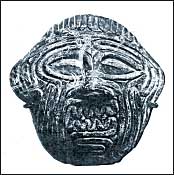
The Gilgamesh Epic describes the first “God is dead” movement. In the Epic, the hero is a vile, filthy, perverted person, yet he is presented as the greatest, strongest, hero that ever lived (Alexander Heidel, 1963: 18). So that the one who sent the Flood will not trouble them anymore, Gilgamesh sets out to kill the perpetrator. He takes with him a friend who is a monstrous half-man, half-animal-Enkidu. Together they go on a long journey to the Cedar Mountain to find and destroy the monster who sent the Flood. Gilgamesh finds him and finally succeeds in cutting off the head of this creature whose name is “Huwawa” (“Humbaba” in the Assyrian version; see Heidel 1963: 34ff).
Is there a connection with the Gilgamesh epic and Genesis 10? Note what Gilgamesh says to Enkidu the half man, half beast, who accompanied him on his journey, found in Tablet III, lines 147-150.
“If I fall,” Gilgamesh says, “I will establish a name for myself. Gilgamesh is fallen, they will say, in combat with terrible Huwawa.”
But the next five lines are missing from all tablets found so far! Can we speculate on what they say? Let's try… We suggest that those five lines include,
“But if I win, …they will say, Gilgamesh, the mighty vanquisher of Huwawa!”
Why do we say that? Because Genesis 10:9 gives us the portion missing from the Gilgamesh tablets. Those lines include. “it is said, Nimrod (or Gilgamesh) the mighty vanquisher of YHWH.” This has to be what is missing from all the clay tablets of the Gilgamesh story. The Gilgamesh Epic calls him Huwawa; the Bible calls Him YHWH.
Alexander Heidel, speaking of the incident as it is found on Tablet V says,
All we can conclude from them [the lost lines] is that Gilgamesh and Enkidu cut off the head of Humbaba (or Huwawa) and that the expedition had a successful issue [ending] (1963: 47).
The missing lines from the Epic are right there in the Bible!
Because of the parallels between Gilgamesh and Nimrod, many scholars agree that Gilgamesh is Nimrod. Continuing with Gilgamesh's fable, he did win, he did vanquish Huwawa and took his head. Therefore, he could come back to Uruk and other cities and tell the people not to worry about YHWH anymore, he is dead. “I killed him over in the Lebanon mountains. So just live however you like, I will be your king and take care of you.”
There are still other parallels between the Bible and the Gilgamesh epic:
“YaHWeH” has a somewhat similar sound to “Huwawa.” Gilgamesh did just as the “sons of god” in Genesis 6 did.
The “sons of god” forcibly took men's wives. The Epic says that is precisely what Gilgamesh did.
The Bible calls Nimrod a tyrant, and Gilgamesh was a tyrant.
There was a flood in the Bible; there is a flood in the Epic.
Cush is mentioned in the Bible, Kish in the Epic.
Erech is mentioned in Scripture; Uruk was Gilgamesh's city.
Gilgamesh made a trip to see the survivor of the Flood. This was more likely Ham than Noah, since “Nimrod” was Ham's grandson!
Historically, Gilgamesh was of the first dynasty of Uruk. As Jacobsen points out (1939: 157), kings before Gilgamesh may be fictional, but not likely. The fact that the Gilgamesh epic also contains the Deluge story would indicate a close link with events immediately following the Flood. S.N. Kramer says,
A few years ago one would have strongly doubted his (historical) existence… we now have the certitude that the time of Gilgamesh corresponds to the earliest period of Mesopotamian history. (Kramer 1959: 117)
What a contrast Psalm 2 is compared with the Gilgamesh Epic!
Why do the nations conspire and the peoples plot in vain? The kings of the Earth take their stand and the rulers gather together against the LORD and against his Anointed One. “Let us break their chains,” they say, “and throw off their fetters.” The One enthroned in heaven laughs, the Lord scoffs at them. Then he rebukes them in his anger and terrifies them in his wrath, saying, “I have installed my King on Zion, my holy hill.” I will proclaim the decree of the LORD: He said to me, “you are my Son, today I have become your Father, Ask of me, and I will make the nations your inheritance, the ends of the Earth your possession. You will rule them with an iron scepter; you will dash them to pieces like pottery.”
Therefore, you kings, be wise; he warned, you rulers of the Earth. Serve the LORD with fear and rejoice with trembling. Kiss the Son, lest he be angry and you be destroyed in your way, for his wrath can flare up in a moment. Blessed are all who take refuge in him.
References and Bibliography
- Brown, F., Driver, S.R., and Briggs, C.A. (abbreviated to BDB), A Hebrew and English Lexicon of the Old Testament.Oxford (Clarendon Press, 1962).
- Cassuto, U., A Commentary on the Book of Genesis, 2 vols. (Jerusalem: Magnes, 1964).
- Frankfort, H., Kingship and the Gods (Chicago: University Press, 1948).
- Heidel, Alexander, The Gilgamesh Epic and Old Testament Parallels (Chicago: University Press, 1963).
- Jacobsen, T., The Sumerian Kinglist (Chicago: University Press, 1939).
- Josephus, Jewish Antiquities. Books IIII (Cambridge MA: Harvard University Press, Loeb Classics, 1998).
- Kautzsch, E., editor, Genesius' Hebrew Grammar (Oxford: Clarendon, 1910).
- Kramer, S. N., editor, History Begins at Sumer (Garden City NY: Doubleday, 1959).
- Keil, C. F., and Delitzsch, P. Commentary on the Old Testament, vol. 1 (Grand Rapids: Eerdmans, 1975).
- Pritchard, J., Ancient Near Eastern Texts and the Old Testament, 3rd edition (Princeton: University Press, 1969).
- Roux, G., Ancient Iraq, 3rd edition (Harmondsworth, Middlesex, UK: Penguin, 1992).
- Thomas, D.W., Documents From Old Testament Times (New York: Thomas Nelson and Sons, 1958).

Nimrod’s cities
More information
- Nimrod is also mentioned in 1 Chronicles 1:10
- What is the land of Shinar?
- Cush (land and the father of Nimrod)
- What is Chaldea?
- Constellations in the Bible
- Constellation Orion
- Ham (grandfather of Nimrod
- FLOOD CATASTROPHE—How many people survived the greatest disaster of all times?
- ORIGIN OF ETHNIC PEOPLE GROUPS—How could all ethnicities come from Noah, his three sons and their wives?
- Genesis and ancient Near Eastern stories of Creation and the Flood: an introduction.
- What is the Tower of Babel? and what is it important?
- Tower of Babel—Is there archaeological evidence of it?
- What is the confusion of languages at Babel?
- Confusion of Languages—Is there any reference in early Mesopotamian literature to what happened at the Tower of Babel?
- Dispersion—from the plain of Shinar
- Origin of Ethnic People Groups—Where did they all come from?
- Summary of the biblical story of the Tower of Babel (God’s Story)
- Who is Peleg, and what is his significance?
 What are the Cities of the Bible? Names, descriptions, locations and types
- Nephilim (sons of god)
 What are the giants in the Bible?
- Wordsearch: Printable / Online version